
Umbrella tree (Heptapleurum actinophyllum)
Heptapleurum actinophyllum is a perennial evergreen woody plant that grows from a multi-stemmed shrub to a tree; young plants can grow on other trees before becoming terrestrial.
Overview
Heptapleurum actinophyllum is a perennial evergreen woody plant that grows from a multi-stemmed shrub to a tree; young plants can grow on other trees before becoming terrestrial.
Origin and habitat
Sources differ on its native range: they include northern Australia, Queensland, and New Guinea, while some also include Java. It occurs in tropical rainforest and gallery forest, where young plants may grow as epiphytes or semi-epiphytes on other rainforest trees. It is native to humid tropical regions and is suited to warm, frost-free conditions; it can also be grown indoors or in greenhouses in temperate regions.
Characteristics
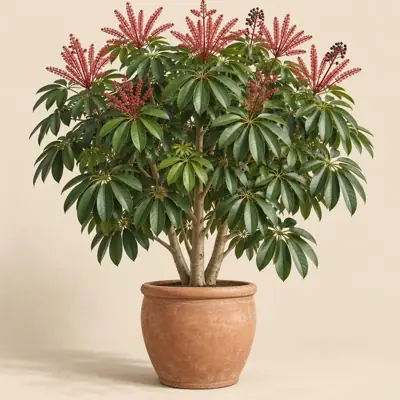
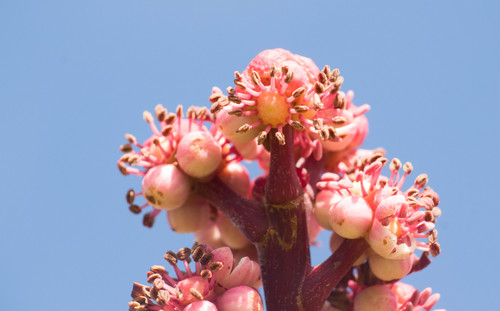
Sources differ on mature height, placing it at about 1000–1500 cm, while a single source reports a mature spread of about 150–250 cm. It is reported to grow rapidly, with evergreen, palmately compound leaves whose leathery, medium- to dark-green leaflets radiate from a central point; sources differ in their descriptions of leaflet dimensions and counts, and mature plants have more leaflets. At the top of the crown it produces upright, radiating red inflorescences with numerous red to dark-red flowers; it is reported to flower mainly from early summer for several months, with horticultural information also describing inflorescences from summer into early autumn. The mature fruits are dark red to purple and may later become black, and are described as multi-seeded, drupe-like fruits.
Light
It grows in bright light to full sun or partial sun; indoors, a bright position is suitable, while strong direct light during hot afternoons should be avoided.
Watering
Keep it moderately moist in a well-drained medium; sources differ between regular and only occasional watering, but standing water should not be used to maintain moisture.
Temperature and dormancy
Sources differ on the minimum temperature, placing it at about 13 °C. A single source reports its USDA hardiness classification.
Growing medium and mounting
It prefers fertile, moist but well-drained soil and can grow in loamy, sandy, or chalky soils across acidic, neutral, and alkaline conditions.
Feeding
It is generally reported to need only moderate or occasional feeding to maintain growth.
Propagation
It can be propagated by seed or cuttings, and layering is also reported as a method.
Common problems
Scale insects, thrips, and mealybugs may occur, and an overly warm overwintering environment may increase scale problems. It is generally reported to have few disease problems. Its roots are reported to spread strongly through surrounding soil, and in suitable regions it may escape cultivation and become invasive; overwintering conditions that are too cold may cause leaf drop, while excessive warmth may cause elongated growth and increase scale problems. It is sensitive to frost and low temperatures and is suited to protected, frost-free conditions; outdoor container plants in temperate regions should be moved indoors for winter.
Identification
The large palmately compound leaves have leaflets radiating from a central point like an umbrella; mature plants also produce conspicuous red, radiating inflorescences at the top of the crown, often compared in appearance to octopus tentacles.
Photos


Sources
- Wikipedia (en): Heptapleurum actinophyllum — CC BY-SA 4.0 · link
- 維基百科:輻葉鵝掌柴 — CC BY-SA 4.0 · link
- Wikipedia (de): Schefflera actinophylla — CC BY-SA 4.0 · link
- Wikipedia (fr): Schefflera actinophylla — CC BY-SA 4.0 · link
- Wikipedia (es): Schefflera actinophylla — CC BY-SA 4.0 · link
- GBIF descriptions: Especies introducidas, exóticas, trasplantadas, invasoras y potencialmente invasoras obtenidas a par — per dataset · link
- NC State Plant Toolbox: Heptapleurum actinophyllum — copyright (facts only) · link
- RHS Plants: Heptapleurum actinophyllum — © RHS, facts only · link