
Fasciated Haworthia (Haworthiopsis fasciata)
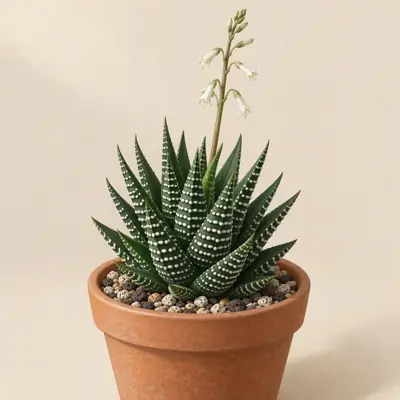
Haworthiopsis fasciata is a low-growing, evergreen perennial succulent that forms rosettes and can produce basal offsets to develop into clumps.
Overview
Haworthiopsis fasciata is a low-growing, evergreen perennial succulent that forms rosettes and can produce basal offsets to develop into clumps.
Origin and habitat
Sources differ on its recorded native range in South Africa's Eastern Cape, with accounts including the vicinity of Port Elizabeth, Uitenhage, and westward to the Brandekraal area. It occurs in scrub or fynbos vegetation in the Eastern Cape, growing in acidic sand, among stones, in rocky soils, and in gaps in grassland.
Characteristics
Sources differ, placing mature height at about 10–18 cm, while mature spread is 10–15.24 cm. Sources differ on growth rate, describing it either as slow-growing or as relatively fast-growing and quick to produce offsets that form small clumps. The thick, firm, fibrous leaves are narrowly triangular to lanceolate-triangular and curve inward, ranging from dark green to gray-green, yellow-green, or brown-green; raised white tubercles on the outer surface merge into transverse bands, while the inner surface is smoother and usually lacks tubercles, and the leaf tip bears a non-sharp spine-like point. It stores water in its leaves and has small, white, tubular flowers borne on slender flower stalks or racemes; flowering is reported in summer, with another account giving a more specific flowering period.
Light
Sources differ on light recommendations: bright to filtered light or part shade is described, including tolerance of lower indoor light, while some sources recommend full sun and cultivation guidance also advises avoiding hot, intense direct sunlight. It is suited to bright light or part shade.
Watering
Use good drainage and avoid waterlogging, allowing the medium to drain thoroughly after watering; most horticultural sources recommend letting it dry noticeably between waterings and keeping it especially dry in winter, as overwatering increases the risk of root and stem rot.
Humidity and airflow
It prefers low humidity and needs good airflow.
Temperature and dormancy
Sources differ on the minimum temperature, with limited evidence placing it at about -5 °C. It is associated with a USDA hardiness range, and a single specialist source reports that it tolerates brief light frost. A single source reports that it rests in summer, while supported accounts say growth slows in high temperatures and dormancy occurs in midsummer, with overheating potentially causing harm during hot periods. A single specialist source places its cold minimum at about -5 °C, with few sources available.
Growing medium and mounting
Use a loose, well-drained succulent or cactus medium; sandy or loamy soil can be used, while sources differ on pH. It needs a fast-draining mix and is generally reported to have low rot risk.
Feeding
During the growing period, feed sparingly with diluted balanced fertilizer or a low-nitrogen fertilizer.
Propagation
It can be propagated by separating basal offsets, by leaf cuttings, or by seed, with leaf cuttings and offsets suitable for propagation in spring and summer.
Common problems
Mealybugs may infest the plant. Excessively wet medium may be associated with rot, leaf spots, and other fungal diseases, although the RHS broadly describes it as usually having few disease problems. A single source reports that overwatering readily causes rot, excessive light can turn the leaves dark red and, in severe cases, pale and dry, while insufficient light can make the leaf markings fade. Avoid severe cold, prolonged frost, cold winds, sudden temperature changes, and intense hot direct sunlight.
Identification
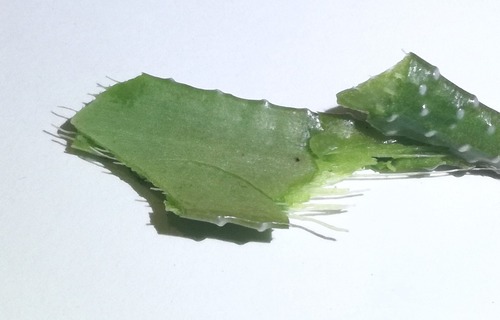
An important visible distinction from Haworthiopsis attenuata is that Haworthiopsis fasciata has a smooth inner leaf surface, with raised white tubercle bands confined to the outer surface; its leaves are also fibrous, unlike those of H. attenuata.
Photos


Sources
- Wikipedia (en): Haworthiopsis fasciata — CC BY-SA 4.0 · link
- NC State Plant Toolbox: Haworthiopsis fasciata — copyright (facts only) · link
- LLIFLE Encyclopedia of living forms: Haworthiopsis fasciata — CC BY-SA · link
- RHS Plants: Haworthiopsis fasciata — © RHS, facts only · link
- Haworthia fasciata - Zebra Plant - Mountain Crest Gardens (mountaincrestgardens.com) — facts only (§12) · link