
Horse's Teeth (Haworthia truncata)
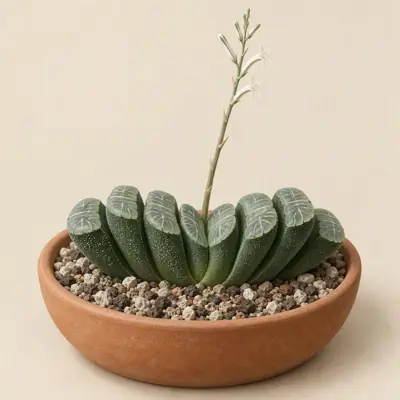
Haworthia truncata is a stemless succulent whose leaves are mainly arranged in opposite rows to form a fan; plants may remain solitary or slowly form clumps. It is a perennial evergreen succulent.
Overview
Haworthia truncata is a stemless succulent whose leaves are mainly arranged in opposite rows to form a fan; plants may remain solitary or slowly form clumps. It is a perennial evergreen succulent.
Origin and habitat
Haworthia truncata is native to the Little Karoo of South Africa's Western Cape, including the Oudtshoorn area, within the southwestern Cape region of South Africa. It inhabits the arid Little Karoo, growing under the shade of shrubs or in open sites; plants are often partly or mostly buried, with only the leaf tips exposed above the ground. Its natural habitat is arid and is reported to receive sparse, intermittent rainfall throughout the year.
Characteristics
Sources differ on mature height, placing it at about 2–10 cm, while mature spread is 10 cm. Growth is slow, and the plant takes several years to develop a fully formed appearance. The thick, succulent leaves range from gray and gray-green to dark green and are usually held upright in opposite rows forming a fan; their horizontally truncated tips have translucent windows marked with white, gray, or green lines, and the leaf surface may bear wart-like projections. Sources differ in their descriptions of the small, inconspicuous flowers: they are tubular, white to greenish white, may have brown veins, and are arranged in racemes or clustered inflorescences; Haworthia plants are reported to flower during a period that varies by kind, and Haworthia truncata stores water in its leaves.
Light
Sources differ on light conditions: bright indirect light, bright shade, or partial sun are described as safer, while the plant can adapt to stronger light and takes full sun; shade is advisable during hot periods, and a sudden move from shade into intense direct sun can cause sunburn.
Watering
Sources differ on watering details: during growth, water thoroughly without allowing standing water and wait until the surface of the growing medium dries before watering again; watering can be reduced during hot summers and cold winters, while good drainage lowers the risk of root rot.
Humidity and airflow
Haworthia truncata is reported to prefer low humidity.
Temperature and dormancy
Sources differ on hardiness and minimum temperature; Haworthia truncata is described as RHS H2, while the few available sources give minimum figures of about -2 °C and about 5 °C. It is reported to be frost tender and should be kept above freezing. It rests in summer. During summer heat, cool shade is suitable; direct sunlight during the hottest periods can cause scorching, and high temperatures suppress growth.
Growing medium and mounting
Use a very well-drained sandy or gritty succulent medium; RHS lists loam or sand with good drainage and indicates a neutral to alkaline pH. Haworthia truncata needs a fast-draining mix and is generally reported to be prone to rot.
Feeding
During growth, feed sparingly with a low-nitrogen cactus or succulent fertilizer; sources give differing schedules, ranging from occasional feeding to more frequent applications of diluted low-nitrogen fertilizer in late spring and summer.
Propagation
Haworthia truncata can be propagated from seed, offsets or division, and sources also record leaf and root cuttings as propagation methods.
Common problems
Possible pests include mealybugs and scale insects, while information for the Haworthia group also mentions aphids, root mealybugs, and fungus gnats. RHS regards disease problems as generally uncommon, but poor drainage, excess moisture, standing water, or overly wet medium during dormancy can create a risk of root rot. A sudden move from shade to intense full sun can cause sunburn. The plant is sensitive to freezing and to intense direct sunlight in hot conditions; in temperate regions it generally needs to overwinter indoors or in a greenhouse.
Identification
Key identifying features are the thick leaves with horizontally truncated tips, translucent windows at the tips, and the characteristic fan-shaped arrangement in opposite rows; wild plants are often partly buried, exposing only the windowed leaf tips.
Photos


Sources
- Wikipedia (en): Haworthia truncata — CC BY-SA 4.0 · link
- 維基百科:绿玉扇 — CC BY-SA 4.0 · link
- Wikipedia (de): Haworthia truncata — CC BY-SA 4.0 · link
- Wikipedia (fr): Haworthia truncata — CC BY-SA 4.0 · link
- LLIFLE Encyclopedia of living forms: Haworthia truncata — CC BY-SA · link
- RHS Plants: Haworthia truncata — © RHS, facts only · link
- Desert-Tropicals: Haworthia truncata — © Philippe Faucon (desert-tropicals.com), facts only · link
- The Succulent Plant Page: Haworthia (genus-level) — © R.J. Hodgkiss, facts only · link
- NHK みんなの趣味の園芸 植物図鑑: Haworthia truncata — © NHK出版, facts only · link
- 多肉植物玉露好難種?掌握 3 照顧關鍵,懶人養出肥美玉露多肉! - 微體溫室 Micro Oasis (micro-oasis.com) — facts only (§12) · link
- Haworthia truncata 'Jolly Green Giant' [large] [limited] | Mountain Crest Garden (mountaincrestgardens.com) — facts only (§12) · link
- Haworthia truncata | Giromagi cactus and succulents for sale | Buy plants online (www.giromagi.com) — facts only (§12) · link