
Haworthia retusa (Haworthia retusa)
Haworthia retusa is a perennial evergreen succulent with no stem or a very short stem, forming compact rosettes; it is mostly solitary in the wild but can produce offsets and form clumps in cultivation.
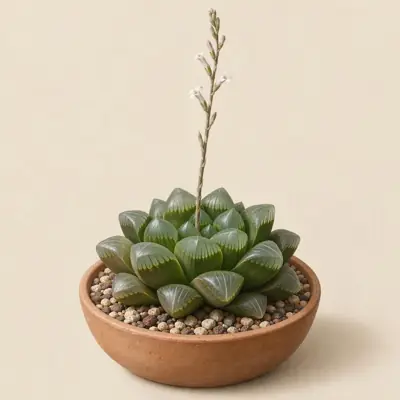
Overview
Haworthia retusa is a perennial evergreen succulent with no stem or a very short stem, forming compact rosettes; it is mostly solitary in the wild but can produce offsets and form clumps in cultivation.
Origin and habitat
Haworthia retusa is native to the Western Cape of South Africa, especially around Riversdale, although sources differ on the extent of its range, with some describing it as extending from Bredasdorp to Mossel Bay and others from Heidelberg to Riversdale. It occurs mainly on low hills and flatter ground, including clayey hills, among rocks, or beneath shrubs; in its native habitat plants are often partly buried, with only the windowed portions of the leaves exposed above the soil. It is reported to occur in semi-arid environments in South Africa, growing in shade provided by rocks or other plants.
Characteristics
Sources are few and differ, placing mature height at about 7.62–15.24 cm and mature spread at about 10.16–15.24 cm. It grows slowly and stores water in its leaves; its thick, fleshy leaves are triangular to triangular-ovate, range from light or bright green to brownish green, may become purple in strong light, and have recurved upper portions ending in relatively flat transparent or translucent windows that often show longitudinal lines. Sources differ on flower color: the small tubular flowers are mainly white and may have greenish-brown veins, while another account records pale pink flowers; they are arranged in racemes. Sources also differ on flowering season, describing flowering from late winter through summer.
Light
Sources differ in their descriptions, but bright, indirect or filtered light is suitable, including morning or evening sun; prolonged strong direct midday sun should be avoided because it may scorch the leaves or reduce their plump appearance. Haworthia retusa tolerates bright light or part shade.
Watering
Use a well-draining medium and water thoroughly, allowing the medium to dry before watering again; reduce watering during dormancy or when growth slows in hot or cold conditions, as prolonged wetness may cause root rot.
Humidity and airflow
Haworthia retusa is reported to prefer low humidity.
Temperature and dormancy
A minimum temperature of -1 °C is reported across sources. It is generally frost tender and should be kept above freezing; it is also reported to rest in summer. Evidence is limited, but a cold minimum of about 0 °C is reported. Strong direct sunlight may slow growth and reduce the plant's plump appearance, while midday sun may scorch the leaves.
Growing medium and mounting
Use a well-draining succulent or cactus medium, which may include sand or perlite to improve drainage; loam or sandy soil and a neutral to alkaline pH are also described. A moderately draining mix is enough.
Feeding
Feed lightly during the growing period with a slow-release or liquid fertilizer; diluted low-nitrogen fertilizer from late spring through summer is also recommended.
Propagation
Haworthia retusa can be propagated by separating offsets or by seed; genus-level horticultural information also describes leaf cuttings and, for some kinds, root cuttings.
Common problems
Possible pests include mealybugs, spider mites, aphids, and fungus gnats; genus-level information also records root mealybugs. Serious diseases are generally uncommon, but overwatering or persistently wet medium can cause root rot. Strong midday sun may scorch leaves, while prolonged strong light may cause browning or reduce their plump appearance. It is frost sensitive and in temperate regions generally requires cultivation in a glasshouse or protected environment; strong midday sun may also cause leaf scorch.
Identification
Key identifying features are the strongly recurved, truncate appearance of the leaves and their flat, glossy, translucent, lined windows at the tips.
Photos


Sources
- Wikipedia (en): Haworthia retusa — CC BY-SA 4.0 · link
- Wikipedia (de): Haworthia retusa — CC BY-SA 4.0 · link
- Wikipedia (fr): Haworthia retusa — CC BY-SA 4.0 · link
- Wikipedia (es): Haworthia retusa — CC BY-SA 4.0 · link
- NC State Plant Toolbox: Haworthia retusa — copyright (facts only) · link
- LLIFLE Encyclopedia of living forms: Haworthia retusa — CC BY-SA · link
- RHS Plants: Haworthia retusa — © RHS, facts only · link
- Desert-Tropicals: Haworthia retusa — © Philippe Faucon (desert-tropicals.com), facts only · link
- The Succulent Plant Page: Haworthia (genus-level) — © R.J. Hodgkiss, facts only · link
- NHK みんなの趣味の園芸 植物図鑑: Haworthia retusa — © NHK出版, facts only · link
- Haworthia retusa | Mountain Crest Gardens™ (mountaincrestgardens.com) — facts only (§12) · link
- Haworthia retusa | Giromagi cactus and succulents for sale | Buy plants online (www.giromagi.com) — facts only (§12) · link
- PUKUBOOK: Haworthia retusa — CC BY-NC (facts only) · link