
Bristle Haworthia (Haworthia cooperi)
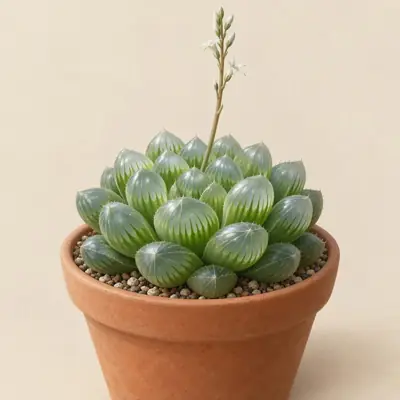
Haworthia cooperi is an evergreen perennial succulent with a stemless, low-growing, clumping rosette habit, often producing offsets from the base.
Overview
Haworthia cooperi is an evergreen perennial succulent with a stemless, low-growing, clumping rosette habit, often producing offsets from the base.
Origin and habitat
Haworthia cooperi is native to South Africa's Eastern Cape, around the area from Port Elizabeth to East London. It occurs on lowland plains, where plants are often buried in soil or sand with mainly their transparent leaf tips exposed at the surface; it is also reported from higher elevations. Its native habitat is reported to lie in a summer-rainfall region.
Characteristics
Sources are few regarding mature height, which is reported at about 0–10 cm, while sources differ on mature spread, reported at about 0–10 cm. It grows slowly and stores water in its leaves; its fleshy leaves range from elongate-oval to lance-shaped and from pale green to gray-green or blue-green, with a plump, somewhat translucent appearance, transparent windows and longitudinal markings at the tips, while tip shape and the presence of awns or fine teeth vary, and stronger light may cause reddish to purple coloration. The small white to nearly white flowers are borne in racemes on slender stalks; sources differ on flowering timing, describing it from spring into summer and giving a native-habitat flowering period extending from late in one year into early in the next. The fruit is generally reported to have the typical characteristics of the genus Haworthia.
Light
Haworthia cooperi is suited to bright light or part shade, with bright filtered or diffuse light described as suitable and lower indoor light also tolerated. Sources differ because some also indicate full sun, while strong direct light may slow growth, reduce the leaves' plump appearance, or turn them red, so excessive exposure in hot conditions is best avoided.
Watering
During active growth, water thoroughly after the growing medium dries and ensure drainage; reduce watering during hot summer dormancy or near-dormancy and during cold winter conditions, avoiding prolonged wetness around the roots. A single source reports a summer watering interval of about 14–21 days, so sources are few for this range.
Humidity and airflow
Haworthia cooperi is generally reported to prefer low humidity.
Temperature and dormancy
The stated minimum temperature is 5 °C, and Haworthia cooperi is generally reported to be frost tender and should be kept above freezing. It rests in summer. Sources differ in their hardiness classifications, with one using an RHS classification and genus-level information elsewhere using a USDA classification. Strong direct sunlight may slow growth, reduce the leaves' plump appearance, and cause red coloration.
Growing medium and mounting
Use a well-drained succulent or cactus growing medium; sandy or loamy material can be supplemented with granular material, and containers should have drainage holes. Haworthia cooperi needs a fast-draining mix and is prone to rot.
Feeding
Feed lightly during active growth; sources describe diluted low-nitrogen fertilizer in the later part of spring through summer or small amounts of slow-release chemical fertilizer or liquid fertilizer during spring and autumn growth, while fertilizer should be avoided during summer dormancy.
Propagation
Haworthia cooperi can be propagated from offsets, by division, and from seed; genus-level horticultural information also describes leaf cuttings and, for some kinds, root cuttings.
Common problems
Mealybugs may affect Haworthia cooperi, while genus-level information also lists scale insects, aphids, root mealybugs, and fungus gnats. Obvious disease problems are generally uncommon, but persistently wet growing medium in summer or winter may cause root rot, and excessive watering or feeding during summer dormancy can impair growth. Excessively strong sunlight can redden leaves, reduce their plump appearance, and may injure them. Cold tolerance is limited, while plants may become dormant in intense summer heat; hot conditions combined with overly wet growing medium carry greater risk, and strong direct sunlight may also stress the plant.
Identification
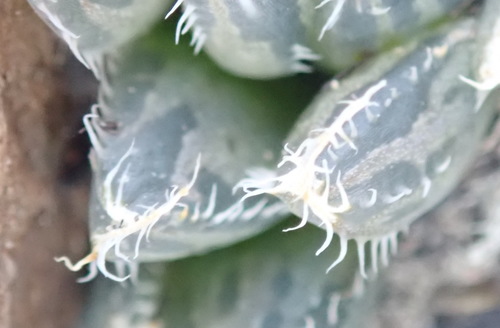
A key feature is the transparent to translucent window tissue at the tips of the fleshy leaves; in the wild, much of the leaf may be buried in soil or sand, leaving the transparent tips near the surface to admit light. Most varieties have fine bristles or awns along the leaf margins, although the varieties differ greatly.
Photos



Sources
- Wikipedia (en): Haworthia cooperi — CC BY-SA 4.0 · link
- Wikipedia (de): Haworthia cooperi — CC BY-SA 4.0 · link
- Wikipedia (es): Haworthia cooperi — CC BY-SA 4.0 · link
- LLIFLE Encyclopedia of living forms: Haworthia cooperi — CC BY-SA · link
- RHS Plants: Haworthia cooperi — © RHS, facts only · link
- Desert-Tropicals: Haworthia cooperi — © Philippe Faucon (desert-tropicals.com), facts only · link
- The Succulent Plant Page: Haworthia (genus-level) — © R.J. Hodgkiss, facts only · link
- NHK みんなの趣味の園芸 植物図鑑: Haworthia cooperi — © NHK出版, facts only · link
- NC State Plant Toolbox: Haworthia (genus-level) — copyright (facts only) · link
- 多肉植物玉露好難種?掌握 3 照顧關鍵,懶人養出肥美玉露多肉! - 微體溫室 Micro Oasis (micro-oasis.com) — facts only (§12) · link
- PUKUBOOK: Haworthia cooperi — CC BY-NC (facts only) · link
- Haworthia cooperi | Mountain Crest Gardens™ (mountaincrestgardens.com) — facts only (§12) · link
- Haworthia cooperi | Giromagi cactus and succulents for sale | Buy plants online (www.giromagi.com) — facts only (§12) · link