
Gymnocalycium anisitsii (Gymnocalycium anisitsii)
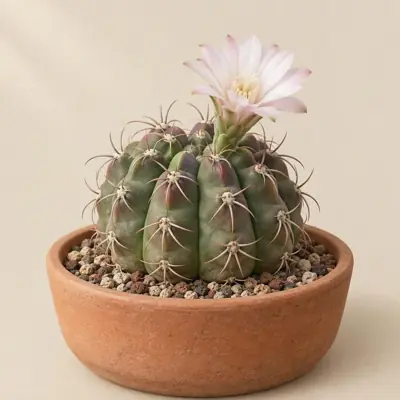
Gymnocalycium anisitsii is a globular to short-columnar cactus that may grow singly or gradually form clumps from offsets.
Overview
Gymnocalycium anisitsii is a globular to short-columnar cactus that may grow singly or gradually form clumps from offsets.
Origin and habitat
It is native to Bolivia, Brazil, and Paraguay, but sources differ on whether its Brazilian range is in the south or central-west. It commonly occurs in open, partly shaded settings sheltered by low xeric shrubs, sometimes in fertile sandy loam, and is less often found on rocky hills or sandy uplands. It occurs mainly in subtropical environments, with frequent summer rainfall; a specialist source also describes its elevational distribution and a possible upper limit.
Characteristics
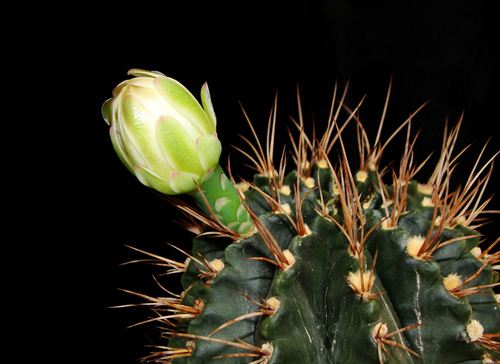
Sources differ, placing mature height at about 5–10 cm and mature spread at about 8–15 cm. Growth is relatively fast, and plants can form clumps under favorable conditions. The funnel-shaped flowers are usually white, greenish white, or pale pink, and may also be bright pink; sources differ in horticultural descriptions of flower size. Under suitable conditions, flowering can continue through nearly the entire year, while the mature fruit is red to reddish brown and elongated oval to long-cylindrical in shape.
Light
It grows in bright light through filtered sun or afternoon shade and can accept some direct sun, but excessive exposure during the hottest part of summer can cause sunburn or suppress growth. A specialist source reports that it tolerates bright light or part shade.
Watering
During summer growth, water moderately to more generously while avoiding overwatering, and keep it dry in winter.
Humidity and airflow
A specialist source reports that it needs good airflow.
Temperature and dormancy
The limited sources differ on a minimum of about -5 °C, while specialist information from few sources reports an ideal range of about 21–27 °C. The supported cold minimum is 0 °C. Specialist sources generally report that it tolerates brief light frost and rests cool and dry in winter.
Growing medium and mounting
Use a very loose, porous, well-drained cactus medium; it prefers a lower pH, and lime-rich substrates should be avoided, while fertile sandy loam is also recorded from the wild. A specialist source reports that it needs a fast-draining mix.
Feeding
A specialist source reports using a high-potassium fertilizer in summer.
Propagation
A specialist source reports propagation by division or seed and describes spring-sown seed germinating under specified warm conditions after a stated period. A specialist source also reports division, direct sowing, and cuttings as propagation methods.
Common problems
A specialist source reports possible problems with spider mites, mealybugs, and scale insects, with root mealybugs being harder to detect. A specialist source reports that fungal diseases are uncommon with good care and that rot is the principal concern. Overwatering can cause rot, lime-rich media can stall growth, and excessive summer exposure can cause sunburn or suppressed growth. A specialist source reports that intense direct summer sun can cause sunburn and that the plant has some short-term frost tolerance under dry conditions.
Identification
Plant height is variable; the stem has ribbed, sharply tuberculate surfaces with radial spines, while central spines are usually absent but may occasionally occur. The epidermis is green and may become pale green, bronze, or reddish purple under strong light.
Photos


Sources
- Wikipedia (en): Gymnocalycium anisitsii — CC BY-SA 4.0 · link
- Wikipedia (de): Gymnocalycium anisitsii — CC BY-SA 4.0 · link
- Wikipedia (fr): Gymnocalycium anisitsii — CC BY-SA 4.0 · link
- Wikipedia (es): Gymnocalycium anisitsii — CC BY-SA 4.0 · link
- LLIFLE Encyclopedia of living forms: Gymnocalycium anisitsii — CC BY-SA · link
- The Succulent Plant Page: Gymnocalycium (genus-level) — © R.J. Hodgkiss, facts only · link
- PUKUBOOK: Gymnocalycium anisitsii — CC BY-NC (facts only) · link