
Ghost-plant (Graptopetalum paraguayense)
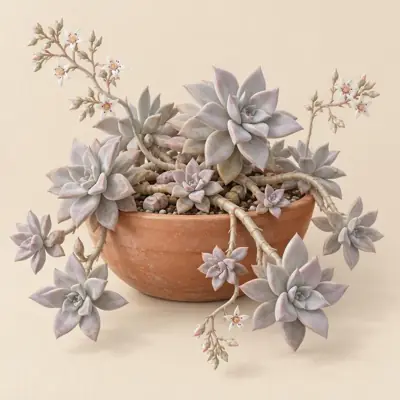
Graptopetalum paraguayense is a perennial, rosette-forming, clumping succulent. Sources describe its habit differently, with stems that may elongate and become creeping, prostrate, or trailing, eventually forming low, spreading clumps.
Overview
Graptopetalum paraguayense is a perennial, rosette-forming, clumping succulent. Sources describe its habit differently, with stems that may elongate and become creeping, prostrate, or trailing, eventually forming low, spreading clumps.
Origin and habitat
Sources differ on the native range: it is placed in Mexico, with more specific accounts pointing to Tamaulipas, Mexico. Wild material is reported to have been found on cliffs and rock faces in Tamaulipas, Mexico. It is reported to be cultivable in temperate climates if protected from rain and excessive moisture, and also suited to warm, frost-free areas.
Characteristics
Sources differ on mature height, giving a range of about 15–30 cm, while mature spread is 50–100 cm. The thick, fleshy leaves range from spoon-shaped or wedge-shaped to obovate or slightly triangular, are spirally arranged into rosettes, and may be gray-green, pale blue-gray, or pink-purple with a white waxy coating; strong light, dryness, or low temperatures can bring out pink or purple tones, and detached leaves can root from the base. It is generally reported to store water in its leaves. Sources differ somewhat in describing the small, star-shaped flowers, which are mainly described as having white to nearly white petals with red spots; flowering occurs mainly in spring, though some horticultural sources also report it extending into or occurring in summer.
Light
Graptopetalum paraguayense does best with abundant light and takes full sun, while also accepting partial sun; insufficient light can make the leaves gray-green and thinner and can cause elongated or drooping growth.
Watering
It is drought tolerant and should be watered after the growing medium dries, while prolonged wetness and poor drainage should be avoided; watering should be reduced during hot summer conditions and also during autumn and winter.
Humidity and airflow
It is reported to prefer low humidity and to need good airflow.
Temperature and dormancy
The minimum temperature is -10 °C. A source reports an RHS H2 hardiness rating and describes the plant as frost hardy. Based on few sources, the reported cold minimum is about -10 °C. In hot, dry conditions the leaves can become pinkish yellow; watering should be avoided during high temperatures and reduced in summer.
Growing medium and mounting
Use a well-drained medium such as sandy loam or potting mix; RHS lists loam and sandy soil and indicates that acidic, neutral, and alkaline conditions are suitable. It needs a fast-draining mix.
Feeding
Sources differ on feeding: fertilizer needs are described as low, with one source saying fertilizer is generally unnecessary but that long-lasting fertilizer may be used periodically when growing for leaves, while other horticultural sources recommend low-nitrogen or slow-release fertilizer during active growth.
Propagation
It is readily propagated from leaf and stem cuttings, and offsets and division can also be used; seed propagation is additionally listed by RHS. Propagation methods listed across sources include leaf cuttings, stem cuttings, division, lateral offsets, stem cutting, and seeds. Detached mature leaves can root from their base and form new plants.
Common problems
Aphids, scale insects, mealybugs, and weevils may occur, although NC State also notes that the plant generally has no significant pest problems. Soft rot may occur under hot, excessively wet, poorly ventilated conditions, while RHS describes the species as generally having few disease problems. Excess moisture, poor drainage, and prolonged exposure to rain can cause poor growth or death, while insufficient light can cause elongated growth, gray-green and thinner leaves, or drooping and leaf loss. It is sensitive to prolonged moisture and rain; tolerance of low temperatures is better when it is kept dry and protected, while hot, dry conditions can turn the leaves pink or yellow-pink.
Identification
Graptopetalum paraguayense forms fleshy, wax-coated gray-white to blue-gray rosettes at the ends of stems that gradually elongate and become creeping or trailing. Leaf color can shift toward pink, purple, or yellow with light and environmental conditions, and the plant bears star-shaped, spotted flowers.
Photos


Sources
- Wikipedia (en): Graptopetalum paraguayense — CC BY-SA 4.0 · link
- 維基百科:风车莲 — CC BY-SA 4.0 · link
- Wikipedia (ja): オボロヅキ — CC BY-SA 4.0 · link
- Wikipedia (de): Graptopetalum paraguayense — CC BY-SA 4.0 · link
- Wikipedia (fr): Graptopetalum paraguayense — CC BY-SA 4.0 · link
- Wikipedia (es): Graptopetalum paraguayense — CC BY-SA 4.0 · link
- NC State Plant Toolbox: Graptopetalum paraguayense — copyright (facts only) · link
- Wikipedia (it): Graptopetalum paraguayense — CC BY-SA 4.0 · link
- Wikipedia (pt): Graptopetalum paraguayense — CC BY-SA 4.0 · link
- 農業知識入口網 植物圖鑑: Graptopetalum paraguayense — © MOA, facts only · link
- LLIFLE Encyclopedia of living forms: Graptopetalum paraguayense — CC BY-SA · link
- RHS Plants: Graptopetalum paraguayense — © RHS, facts only · link
- NHK みんなの趣味の園芸 植物図鑑: Graptopetalum paraguayense — © NHK出版, facts only · link
- Ghost Plant - Graptopetalum paraguayense | MCG™ (mountaincrestgardens.com) — facts only (§12) · link