
common globe amaranth (Gomphrena globosa)
Gomphrena globosa is an upright, branching herb that may form a dense clump, with hairs on the whole plant or on young growth. It is an annual herb but can be grown as a perennial in warmer zones.
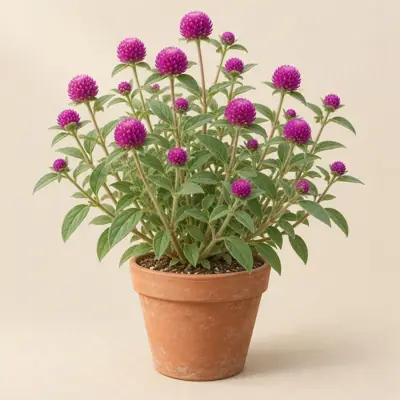
Overview
Gomphrena globosa is an upright, branching herb that may form a dense clump, with hairs on the whole plant or on young growth. It is an annual herb but can be grown as a perennial in warmer zones.
Origin and habitat
Gomphrena globosa is native to tropical America, but sources differ on the more precise native range, variously placing it in Central America, from Mexico to Brazil, in Central and South America, or in South America. Its habitat is described as tropical forest, and it is also widely cultivated. It is a tropical plant adapted to hot conditions, with heat tolerance and some drought tolerance.
Characteristics
Sources differ on mature height, giving a range of about 15–90 cm. Mature spread is 15.24–50 cm. The hairy, entire leaves are simple and opposite, ranging in shape from narrow and elongated to oblong, elliptic, or ovate. The dense flower heads are globose to oblong, with tiny, inconspicuous true flowers and papery ornamental structures in colors including magenta, purple, red, pink, white, orange, and pale purple; sources differ in their descriptions of flower-head and flower size, and flowering occurs mainly from summer into early autumn or autumn.
Light
Grow in full sun; insufficient sunlight may make flowering difficult or reduce the number of flowers.
Watering
During growth, regular watering with moist but well-drained conditions is preferred; established plants tolerate drought and relatively dry soil.
Temperature and dormancy
In warmer hardiness zones it can be grown as a perennial, and another source assigns it a separate cold-hardiness rating. It is reported to be frost tender; keep above freezing.
Growing medium and mounting
Well-drained soil with moderate fertility is suitable, and the plant can adapt to loam, sand, clay, and chalk; sources differ on preferred soil reaction, with one favoring moist, well-drained, fertile, acidic soil and another allowing acidic, neutral, or alkaline conditions.
Feeding
It is generally reported not to require heavy feeding; if fertilizer is used, a source recommends one lower in nitrogen.
Propagation
Propagation is mainly by seed, with spring sowing considered suitable; the seeds need only a thin covering of soil. Seedlings can be planted out after true leaves develop, and a Japanese source notes that larger seedlings may establish less readily after transplanting.
Common problems
Significant pest problems are generally uncommon, and deer are also reported not to favor browsing the plant. Significant disease problems are generally reported to be uncommon. Insufficient sunlight is reported to make flowering difficult or sparse. The plant tolerates high temperatures and has some to good drought tolerance; planting out after the last frost is recommended by one source.
Identification
The most conspicuous features are the rounded, brightly colored flower heads, which retain their shape and color for a long time after drying; the true flowers are very small, and the visible display is formed mainly by papery structures.
Photos


Sources
- Wikipedia (en): Gomphrena globosa — CC BY-SA 4.0 · link
- 維基百科:千日紅 — CC BY-SA 4.0 · link
- Wikipedia (ja): センニチコウ — CC BY-SA 4.0 · link
- Wikipedia (de): Echter Kugelamarant — CC BY-SA 4.0 · link
- Wikipedia (fr): Gomphrena globosa — CC BY-SA 4.0 · link
- GBIF descriptions: The checklist of alien seed plants of D.R. Congo, based on evidence from herbarium collections; List — per dataset · link
- NC State Plant Toolbox: Gomphrena globosa — copyright (facts only) · link
- TaiCOL 臺灣物種名錄: Gomphrena globosa — CC BY 4.0 · link
- 農業知識入口網 植物圖鑑: Gomphrena globosa — © MOA, facts only · link
- RHS Plants: Gomphrena globosa — © RHS, facts only · link
- USDA PLANTS Database: Gomphrena globosa — Public domain (US Government work) · link