
Pin-stripe calathea (Goeppertia ornata)
Goeppertia ornata is an upright, densely clumping, evergreen rhizomatous perennial herb.
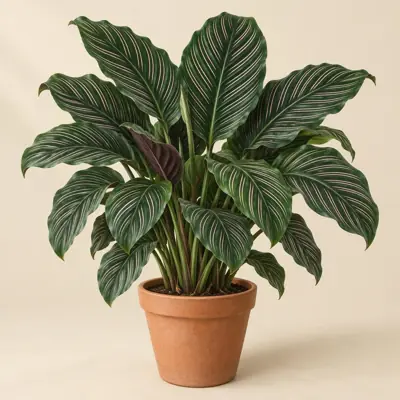
Overview
Goeppertia ornata is an upright, densely clumping, evergreen rhizomatous perennial herb.
Origin and habitat
Goeppertia ornata is native from southeastern Colombia to southwestern Venezuela. It is reported to occur in the understory of tropical rainforest. Its native environment is tropical and highly humid.
Characteristics
Sources differ on mature size, reporting a height of about 50–100 cm and a spread of about 10–50 cm. Sources describe the simple leaves somewhat differently: they are broadly ovate to elliptic, with young leaves bright green and marked by paired fine stripes from pale pink to pinkish white extending outward from the midrib, while mature upper surfaces become dark green; the blades may be glossy, their margins range from entire to slightly wavy, and mature leaf undersides often have a purple tone. Sources differ in their descriptions of the flowers; horticultural accounts describe them as small, tubular, borne in spikes, and white, with flowering rare when grown indoors. Flowering occurs from late spring through summer.
Light
Provide bright indirect or filtered light, or partial shade, and avoid excessively strong direct sunlight.
Watering
During the growing season, keep the growing medium moist but well drained, without allowing it to dry out completely or overwatering; reduce watering in winter.
Humidity and airflow
A single source reports humidity of about 60%.
Temperature and dormancy
A single source reports a minimum temperature of about 16 °C. The plant is assigned to USDA hardiness zones and an RHS hardiness category.
Growing medium and mounting
Use well-drained loam or potting medium that retains moderate moisture; suitable options include medium for African violets or peat-based formulations, while the RHS recommends a peat-free potting medium. The medium may range from acidic through neutral to alkaline.
Feeding
During the growing season, apply a general houseplant fertilizer or balanced liquid fertilizer monthly.
Propagation
Propagate by dividing the rhizomes; the RHS recommends division in late spring and maintaining warm, highly humid conditions while divisions re-establish.
Common problems
Potential pests include spider mites, thrips, mealybugs, whiteflies, and scale insects. The plant may generally have few diseases, but prolonged leaf wetness or poor airflow can be associated with leaf spots, and overwatering can cause root rot. A single source reports that insufficient water may cause leaf curling, while cold drafts, insufficient humidity, or excessively strong direct sunlight may cause leaf browning; wet leaves or poor airflow may also lead to leaf spots. It requires warm, highly humid, sheltered conditions and is sensitive to cold drafts, dryness, and excessively strong direct sunlight.
Identification
A principal ornamental feature is the dark green upper leaf surface with fine pale-pink to pinkish-white stripes extending outward from the midrib; the leaves close or fold upward at night and unfold again after sunrise. Sources differ on whether fine hairs on the leaf surface can be used to distinguish the true species.
Photos

