
brainplant (Goeppertia makoyana)
Goeppertia makoyana is a clumping, upright, evergreen rhizomatous herb and an evergreen perennial.
Overview
Goeppertia makoyana is a clumping, upright, evergreen rhizomatous herb and an evergreen perennial.
Origin and habitat
Goeppertia makoyana is native to southeastern Brazil, explicitly including Espírito Santo. It is reported from tropical rainforest in southeastern Brazil. It favors warm, shaded, highly humid tropical conditions and does not tolerate frost, low temperatures, or strong temperature fluctuations.
Characteristics
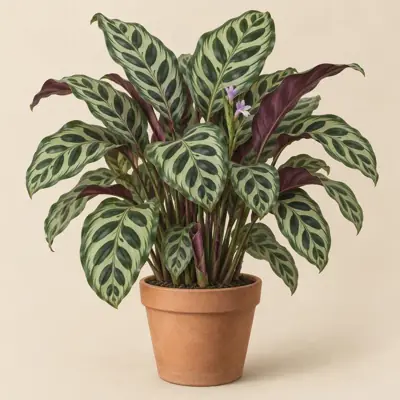
Sources differ on mature size, placing height at about 30.48–50 cm and spread at about 20.32–30.48 cm. The long-stalked, thin, nearly papery leaves are mainly ovate to elliptical, with pale green, silvery green to creamy green surfaces marked by dark green patterns along the veins and on either side of the midrib, and purple to reddish-purple undersides; newly rolled leaves reveal pink-red undersides, and the leaves rise and close at night before opening again after sunrise. The small white and purple tubular flowers may occur in pairs in spike-like or raceme-like inflorescences with green bracts, and flowering is rare indoors. Flowering is reported to occur in summer.
Light
It favors bright indirect or filtered light or partial shade and can tolerate lower light, while direct or excessively strong light may scorch the leaves and insufficient light may cause the leaf color to fade.
Watering
Keep the growing medium moist but not waterlogged or muddy, and reduce watering in winter; NC State recommends distilled water or rainwater to reduce the risk of leaf browning from fluoride in tap water.
Humidity and airflow
It is reported to prefer high humidity, with the few available sources indicating about 60 %, and it is also reported to need little air movement.
Temperature and dormancy
The few available sources indicate a minimum temperature of about 16 °C. Hardiness-zone classifications are also reported.
Growing medium and mounting
A moist but well-drained growing medium is favored, with a high-organic-matter medium preferred for containers and perlite usable to improve drainage. Sources describe soil conditions differently: NC State lists loam and acidic to neutral conditions, while RHS reports adaptation to a broader range of soil types and pH conditions.
Feeding
It is generally recommended to apply a balanced fertilizer during the growing season and stop feeding in winter.
Propagation
Propagation is by division, with the rhizomes suitable for division in late spring.
Common problems
Possible pests include aphids, scale insects, mealybugs, and spider mites, including greenhouse red spider mite. Serious disease problems are generally absent, but overwatering may cause root rot. Low humidity may cause leaves to curl or brown, fluoride in tap water may cause browning, direct sunlight may scorch leaves, insufficient light may fade leaf color, and overwatering may cause root rot. It does not tolerate low humidity, low or unstable temperatures, cold drafts, frost, or strong direct sunlight and is suited to warm, sheltered conditions.
Identification
Its most conspicuous features are the dark green feather-like elliptical markings on the pale leaf surfaces and the purplish-red undersides, creating a pattern described as resembling peacock tail feathers; the leaves also rise at night and open during the day.
Photos

