
Goeppertia lancifolia (Goeppertia lancifolia)
Goeppertia lancifolia is an evergreen perennial herb with a clumping, rounded to outward-spreading habit and rhizomes.
Overview
Goeppertia lancifolia is an evergreen perennial herb with a clumping, rounded to outward-spreading habit and rhizomes.
Origin and habitat
Goeppertia lancifolia is native to southeastern Brazil, with the RHS more specifically placing it in the Rio de Janeiro region of Brazil. It is reported to inhabit rainforest in southeastern Brazil. It is reported to favor a tropical environment with high humidity and to be intolerant of frost.
Characteristics
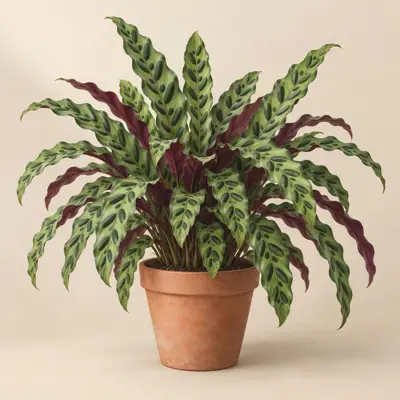
Sources differ on mature size, giving an approximate height range of 50–100 cm and an approximate spread range of 10–50 cm. It is reported to grow quickly and has simple, narrow lance-shaped to elongate linear leaves with wavy margins, medium to pale green upper surfaces marked by dark green to nearly black oval markings along both sides of the midrib, and dark purple to purplish-red undersides; the leaves fold together at night and reopen after sunrise. Small yellow to yellow-green tubular flowers form short, nearly conical spikes; flowering is rare in indoor cultivation and occurs from late spring through summer. The fruit is reported to be a capsule.
Light
It does well in bright indirect or filtered light to partial shade, can accept morning or diffused sunlight, and should be kept out of full sun.
Watering
During the growing season, water regularly to keep the growing medium evenly moist without waterlogging; reduce watering in winter while keeping the medium slightly moist.
Humidity and airflow
It prefers high humidity and needs little air movement.
Temperature and dormancy
Based on few sources, the reported minimum temperature is about 16 °C. A USDA hardiness zone classification is reported for the species.
Growing medium and mounting
Sources describe the growing medium differently: it should be well drained yet moisture-retentive and rich in organic matter, while reported suitable soil reactions range from acidic to neutral in one source and from acidic through alkaline in another, which also lists chalk, clay, and loam.
Feeding
Apply a balanced fertilizer monthly during the spring and summer growing season, and reduce feeding in winter.
Propagation
Propagation is by division, with the RHS recommending late spring.
Common problems
Potential pests include aphids, scale insects, mealybugs, spider mites, greenhouse whiteflies, and greenhouse red spider mites. Sources describe disease problems differently: overwatering may cause root rot and wetting the leaves during watering may encourage fungal leaf spot, while the RHS describes the plant as generally having few disease problems. It is reported that either overwatering or underwatering may cause yellow leaves, low humidity may cause leaf edges and tips to brown and curl, and overwatering may lead to root rot. It does not tolerate frost, strong direct sunlight, drafts, or sudden temperature changes and is suited to a sheltered environment.
Identification
The narrow, elongated, wavy leaves have alternating larger and smaller dark oval markings and purple to purplish-red undersides; the pattern gives the plant its English common name, rattlesnake plant.