
Rattlesnake-plant (Goeppertia insignis)
Goeppertia insignis is an evergreen perennial herb with a clumping, fountain-like, spreading habit.
Overview
Goeppertia insignis is an evergreen perennial herb with a clumping, fountain-like, spreading habit.
Origin and habitat
Goeppertia insignis is native to the area around Rio de Janeiro state in Brazil. It is reported to occur in rainforest in southeastern Brazil. It is associated with tropical environments and is commonly grown indoors in temperate regions.
Characteristics
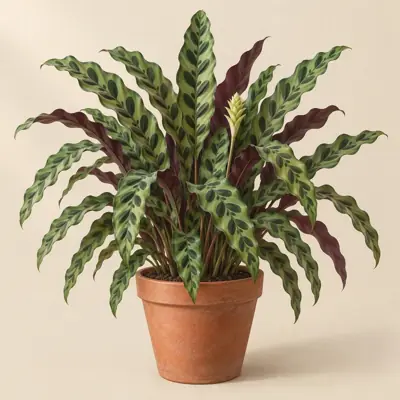
Sources differ on mature height, placing it at about 60–75 cm. Few sources report mature spread, at about 10–50 cm. The leaves are slender, lance-shaped, upright to arching, and wavy-edged, with pale green upper surfaces marked by dark green to nearly black patterns along both sides of the midrib and deep purple undersides; they fold together at night and reopen after sunrise. The small, pale green to yellow flowers form short, upright spike-like or panicle-like inflorescences, appear from late spring through summer, and are less common when the plant is grown indoors.
Light
It grows in bright indirect light, filtered light, or partial shade and can accept morning or diffuse sunlight, but it does not tolerate full sun.
Watering
During the growing season, water regularly to keep the growing medium evenly moist without waterlogging; reduce watering in winter while keeping the medium slightly moist, and use a well-drained medium.
Humidity and airflow
Goeppertia insignis prefers high humidity.
Temperature and dormancy
The minimum temperature is 16 °C.
Growing medium and mounting
Use a well-drained growing medium that retains moisture; indoors, a well-drained peat-based or peat-free potting medium can be used. Sources differ on acceptable pH, describing conditions ranging from acidic and neutral to alkaline.
Feeding
Apply a balanced fertilizer regularly during the growing season, and reduce or stop regular feeding in winter.
Propagation
It is reported to be propagated by division in late spring.
Common problems
Potential pests include aphids, scale insects, mealybugs, spider mites, greenhouse whiteflies, and greenhouse red spider mites. Sources differ on disease problems: overwatering may cause root rot and wetting the leaves during watering may promote fungal leaf spot, while RHS describes the species as generally having few disease problems. It is reported that either overwatering or underwatering may cause yellowing leaves, while low humidity may cause browning or curling of leaf edges or tips. It does not tolerate frost, full sun, drafts, or sudden temperature changes and should be kept in a sheltered environment with stable temperatures.
Identification
Goeppertia insignis can be distinguished by its pale green, long lance-shaped leaves with alternating dark markings of different sizes, wavy margins, and deep purple undersides; the markings resemble a rattlesnake pattern.
Photos

