
Gladiolus hybrid (Gladiolus hybrid)
Gladiolus hybridus is reported to be a perennial cormous plant with an upright, clumping habit, producing upright clusters of leaves and flower stalks from its corms.
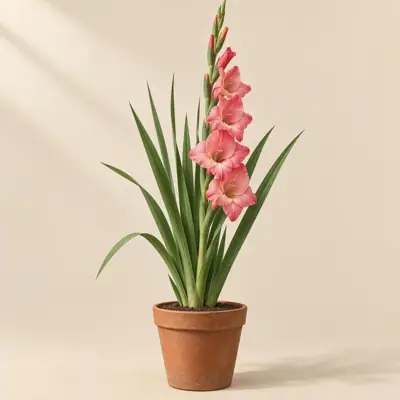
Overview
Gladiolus hybridus is reported to be a perennial cormous plant with an upright, clumping habit, producing upright clusters of leaves and flower stalks from its corms.
Origin and habitat
Sources differ in describing the range of the genus Gladiolus: accounts include Africa, Madagascar and Eurasia, while another includes Asia, Mediterranean Europe, South Africa and tropical Africa and identifies the Cape Floristic Region as the center of species diversity.
Characteristics
It is reported to reach about 30.48–182.88 cm in height and about 30.48–60.96 cm in spread; these ranges come from few sources. Growth is reported to be moderate, with green, narrow, sword-shaped, longitudinally grooved leaves that are usually upright and fan-like. It is reported to bear funnel-shaped flowers on spikes along relatively slender flower stalks, opening progressively upward; cultivated forms occur in white, cream, yellow, green, orange, pink, red and purple shades and can be used as cut flowers, with flowering from late summer into autumn. The fruit is reported to be a capsule ranging from elongated or elliptical to nearly spherical and usually containing many brown, winged seeds.
Light
It is reported to grow in full sun to partial shade, with a preference for full sun or conditions that remain sunny into the afternoon.
Watering
During growth, it is reported to need consistent moisture without the soil drying out completely and can grow in moist, well-drained soil; large-flowered forms especially require moisture during the growing season.
Temperature and dormancy
Sources differ on its hardiness, including a distinction between Gladiolus hybridus generally and the Nanus hybrid group. It is reported to be frost tender and should be kept above freezing.
Growing medium and mounting
It is reported to prefer moist, well-drained loam rich in organic matter and to adapt to most soils, but not heavy clay.
Propagation
It is reported to be propagated by separating small corms produced by the parent corm or by seed, with division also recommended as a propagation method.
Common problems
Reported pests include thrips, aphids, mealybugs, spider mites and bulb mites; another account reports that some bees may bore into flowers, causing them to collapse and die. Reported disease problems include gray mold, crown rot, Phytophthora root and crown rot, rust, wilt, southern blight and mosaic-virus-related problems. Large-flowered forms may require individual support for their flower stalks, while thrips and fungi may cause problems during growth and corm storage. It is reported to prefer shelter from strong winds; most types and hybrids require corms to be lifted and stored frost-free through temperate winters, with exceptions among some hardy types and the Nanus hybrid group.
Identification
It is reported to be distinguished by corms, upright sword-shaped leaves, and conspicuous flower spikes bearing funnel-shaped flowers; commercial large-flowered spikes are the result of prolonged hybridization and selection.