
African daisy (Gerbera jamesonii)
Gerbera jamesonii is a perennial herb that grows in clumps as a basal rosette, with flower stalks emerging from the basal leaves.
Overview
Gerbera jamesonii is a perennial herb that grows in clumps as a basal rosette, with flower stalks emerging from the basal leaves.
Origin and habitat
It is native to southeastern Africa, including parts of Mpumalanga and Limpopo in South Africa and Eswatini; some sources describe the range more broadly as northern South Africa to Eswatini or southern Africa. It is reported from rocky woodland slopes, usually in somewhat shaded sites such as beneath shrubs or trees.
Characteristics
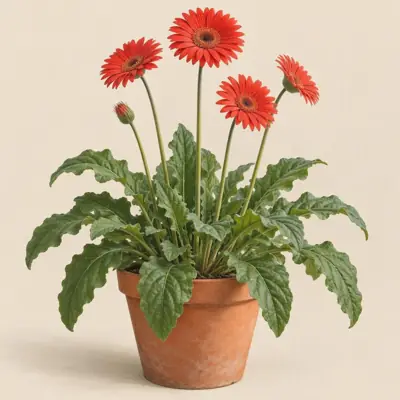
With few sources available, mature height is reported at about 50–100 cm and mature spread at about 10–50 cm. The stalked leaves form a basal rosette and may have deeply wavy or divided margins, with shapes ranging from elliptic and oblong to lanceolate. The daisy-like flower heads generally have orange-red to red ray florets, with yellow, orange, white or pink occurring less often, and they open progressively from the outside inward. Sources differ on flowering time, which varies with region and growing conditions; the lightweight seeds have bristly hairs and can be dispersed by wind.
Light
Sources describe light conditions differently: cultivation generally favors full sun, with strong afternoon sun avoided in hot climates, while wild plants also occur in partly shaded woodland sites.
Watering
Keep the soil moist but well drained and avoid waterlogging, as excessively wet soil may lead to root rot.
Temperature and dormancy
It is reported to be frost tender and should be kept above freezing.
Growing medium and mounting
It grows in fertile, well-drained soil, including loam, sandy or chalky soils, and can tolerate acidic, neutral or alkaline conditions; soil rich in organic matter is also recommended.
Feeding
A small amount of fertilizer is generally reported to be suitable during cultivation.
Propagation
It can be propagated by seed or division; for home gardening, division in early spring and basal or heel side-shoot cuttings in summer are also described.
Common problems
Potential pests include aphids, leaf miners, greenhouse whiteflies, Bemisia whiteflies, thrips, spider mites, broad mites and other tarsonemid mites. Reported diseases include root rot, gray mold, powdery mildew, leaf spots, leaf blights and anthracnose, with associated pathogens including Phytophthora tentaculata, Rhizoctonia solani, Pythium irregulare, Botrytis cinerea and Alternaria. Persistently wet or waterlogged soil can promote root rot, while gray mold, powdery mildew and sap-sucking or leaf-mining pests are also concerns. In cold regions it requires frost-free overwintering, while strong afternoon sun should be avoided in hot climates.
Identification
Gerbera jamesonii forms a dense basal rosette, from which taller, nearly leafless flower stalks rise, each bearing a single conspicuous daisy-like flower head at the tip.
Photos


Sources
- Wikipedia (en): Gerbera jamesonii — CC BY-SA 4.0 · link
- 維基百科:非洲菊 — CC BY-SA 4.0 · link
- Wikipedia (es): Gerbera jamesonii — CC BY-SA 4.0 · link
- GBIF descriptions: Especies introducidas, exóticas, trasplantadas, invasoras y potencialmente invasoras obtenidas a par — per dataset · link
- NC State Plant Toolbox: Gerbera jamesonii — copyright (facts only) · link
- RHS Plants: Gerbera jamesonii — © RHS, facts only · link
- USDA PLANTS Database: Gerbera jamesonii — Public domain (US Government work) · link