
Keeled Oxtongue (Gasteria carinata)
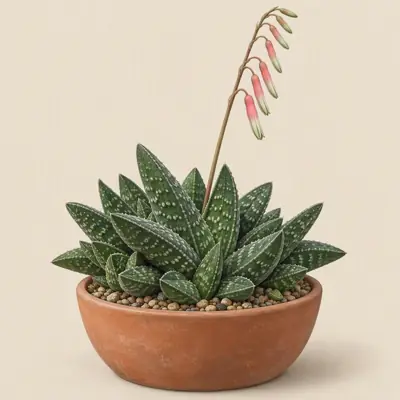
Gasteria carinata is a small to medium-sized, stemless succulent that may grow from prostrate to upright and produces basal offsets that form dense clumps. It is an evergreen perennial succulent.
Overview
Gasteria carinata is a small to medium-sized, stemless succulent that may grow from prostrate to upright and produces basal offsets that form dense clumps. It is an evergreen perennial succulent.
Origin and habitat
Sources differ on the precise native range, but place Gasteria carinata in the southern Western Cape of South Africa, extending roughly from the Hermanus, Riviersonderend, and southern Langeberg area eastward to Mossel Bay. It grows in rocky settings within Renosterveld and Fynbos vegetation, including hills, river valleys, vertical rock faces, shale and sandstone outcrops, and occasionally limestone, in both shrub-shaded and more open positions. Its native habitat extends from near sea level into higher elevations, with relatively modest annual rainfall; rain can fall in both winter and summer, although summers are drier, with hot summer days and cooler nights, mild winters, and occasional light frost.
Characteristics
Sources differ on mature height, placing it at about 3–18 cm, while mature spread is 15–80 cm; growth is generally reported to be slow. The fleshy leaves, which store water, are usually triangular to triangular-lanceolate; young leaves are often arranged in two ranks like a fan, while mature plants commonly form rosettes, with leaves that may be flat or grooved above and often have a prominent keel below, dark to light green coloring, raised white spots or tubercles in bands or transverse rows, and tips varying from sharp to blunt, truncate, or notched among different forms. The flowers are pinkish, with a swollen base narrowing into a tube and a pale pink to white tip marked by a central green stripe; the inflorescence is usually unbranched but may occasionally have a pair of lateral branches, and sources differ on flowering details while placing flowering from Southern Hemisphere winter through late spring with a spring peak. The fruit is a capsule containing seeds.
Light
Gasteria carinata generally does well in bright light or part shade and can tolerate lower light, while prolonged strong direct sun may turn the leaves brown. Cultivation information generally recommends bright shade throughout the year together with good ventilation.
Watering
It is generally recommended to use a well-drained medium, water thoroughly after the medium has dried, and avoid standing water. Watering can be thorough during spring and autumn growth, with less water in midsummer and winter, while prolonged wetness on the leaves should generally be avoided.
Humidity and airflow
It is generally reported to prefer low humidity and need good airflow.
Temperature and dormancy
Sources differ on the minimum temperature, placing it around 0 °C, while the few specialist information available reports a cold minimum around -1 °C. A USDA hardiness zone is reported for cultivation, and the plant is reported to tolerate brief light frost. It is reported to rest in winter. During hot periods the plant may overheat and has somewhat limited heat tolerance.
Growing medium and mounting
Cultivation information generally recommends a granular, well-drained medium and describes a Gasteria mix using medium-grade akadama, medium-grade kanuma, medium-grade pumice, and leaf mold. It needs a fast-draining mix and is reported to have low rot risk.
Feeding
Only a small amount of fertilizer is needed; species-level information recommends diluted balanced fertilizer during the growing season or organic fertilizer, while genus-level information also recommends a small amount of slow-release base fertilizer when repotting in spring.
Propagation
Gasteria carinata can be propagated by separating basal offsets or by leaf cuttings, and genus-level Gasteria information also records propagation from seed.
Common problems
Scale insects are reported to occur around the leaf bases, especially under hot, dry conditions, although Gasteria as a whole is described as relatively resistant to most pests. Soft rot may occur in hot, humid conditions, while overly wet medium during cool periods can lead to root and stem rot. Humidity and condensation may promote black spots on the leaves, prolonged rain may leave leaf blemishes, and waterlogged potting medium can promote rot, particularly in cool periods. Prolonged heat and high humidity or extended rain are unsuitable, and cold tolerance is limited; although light frost occasionally occurs in its native habitat, cultivation sources recommend avoiding frost.
Identification
Gasteria carinata is highly variable within the species; typical features include spotted fleshy leaves, a keel commonly present on mature leaves, two-ranked juvenile leaves that often become rosette-forming at maturity, and ready production of basal shoots that form dense clumps. Leaf surfaces vary among varieties from smooth to densely covered with wart-like projections.
Photos


Sources
- Wikipedia (en): Gasteria carinata — CC BY-SA 4.0 · link
- Wikipedia (de): Gasteria carinata — CC BY-SA 4.0 · link
- Wikipedia (es): Gasteria carinata — CC BY-SA 4.0 · link
- LLIFLE Encyclopedia of living forms: Gasteria carinata — CC BY-SA · link
- The Succulent Plant Page: Gasteria (genus-level) — © R.J. Hodgkiss, facts only · link
- NHK みんなの趣味の園芸 植物図鑑: Gasteria (genus-level) — © NHK出版, facts only · link
- PUKUBOOK: Gasteria carinata — CC BY-NC (facts only) · link
- Gasteria carinata var. carinata | Mountain Crest Gardens™ (mountaincrestgardens.com) — facts only (§12) · link
- Gasteria carinata | Giromagi cactus and succulents for sale | Buy plants online (www.giromagi.com) — facts only (§12) · link