
Gasteria (Gasteria bicolor)
Gasteria bicolor is a succulent that can grow from creeping to upright, branching from the base to form small clumps, with leaves arranged in opposite rows or in rosettes. It is reported to be an evergreen perennial succulent.
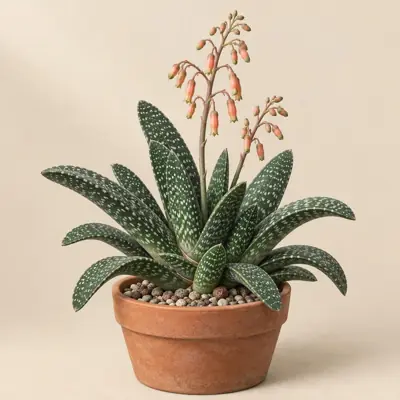
Overview
Gasteria bicolor is a succulent that can grow from creeping to upright, branching from the base to form small clumps, with leaves arranged in opposite rows or in rosettes. It is reported to be an evergreen perennial succulent.
Origin and habitat
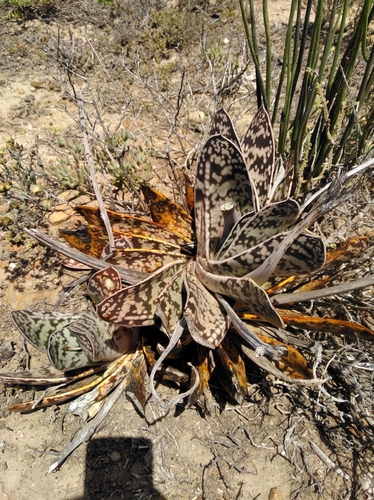
Gasteria bicolor is native to the Eastern Cape of South Africa, with a broad range recorded by Llifle from Humansdorp eastward and northward to Pearston. It grows on rocky slopes, rocky outcrops, and shallow soils in scrub vegetation, often shaded by other plants, trees, or shrubs. Much of its native habitat lies in a summer-rainfall region.
Characteristics
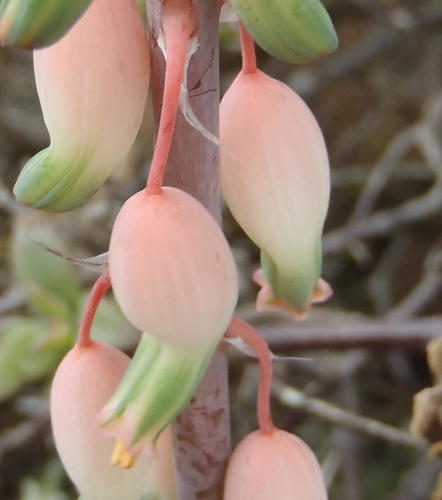
Sources differ on mature height, giving a range of about 8–70 cm, while the limited evidence reports a mature spread of about 0–100 cm. Growth is slow, and the thick, fleshy, dark green to gray-green leaves often have white or cream spots; they range from nearly linear or strap-shaped to tongue-shaped, may be arranged in opposite rows or spirally in a rosette, are mostly smooth and glossy, have entire to finely toothed margins, and may develop an asymmetric keel when spirally arranged. The pendent flowers are tubular to bell-shaped and often bicolored, with pink, red-orange, and green coloration; a German source also records occasional white flowers, and sources differ on flowering season, describing winter through spring with spring clearly included, while some report that flowering can occur year-round and is strongest from midwinter through spring. Sources differ in descriptions of the capsule and seeds; the seeds are small, and Llifle describes them as black and winged for wind dispersal; the plant stores water in its leaves.
Light
Gasteria bicolor does well in bright, indirect light to part shade, tolerates some shade, and should be protected from prolonged strong afternoon sun or excessive direct sunlight. It tolerates bright light or part shade.
Watering
Use a well-drained medium and avoid prolonged waterlogging after watering during the growing season; in summer the medium can remain slightly moist but not overly wet, while in winter watering should be reduced until the medium has dried completely before watering again.
Humidity and airflow
It is reported to prefer low humidity and to need good airflow.
Temperature and dormancy
Sources differ on the lower temperature guidance, with limited evidence giving about 5 °C, while another limited specialist source reports about -1 °C as a cold minimum. It is reported to be frost tender and should be kept above freezing. A single source places it in the listed USDA hardiness zones, and reports greater susceptibility to soft rot in hot, humid conditions and recommends reducing watering in high temperatures.
Growing medium and mounting
Gasteria bicolor prefers a well-drained, porous succulent medium; cactus and succulent potting mix can be used, and sources also indicate that the species adapts to a broad range of soil conditions. It needs a fast-draining mix.
Feeding
Only light feeding is needed during the growing season, using diluted balanced fertilizer or succulent fertilizer; another genus-level source suggests a small amount of slow-release base fertilizer when repotting in spring.
Propagation
Gasteria bicolor can be propagated by separating basal offshoots, by leaf cuttings, including broken leaves or leaf sections that can root, and by seed.
Common problems
Potential pests include scale insects, mealybugs, and leaf mites. Excess moisture can cause root rot, while moisture, condensation, or prolonged rain can cause leaf spotting. Strong, prolonged direct sunlight can turn leaves brown, while other physiological stress can turn them red. The plant is sensitive to cold and frost and should be protected during winter in temperate regions; strong exposure can redden the leaves, and direct light on hot afternoons should be shaded.
Identification
The species is highly variable, commonly with dark green fleshy leaves marked with white spots; leaves often begin in opposite rows on young plants and may later become spiral or rosette-arranged, the base readily branches to form clumps, and the bicolored tubular flowers resemble small stomachs.
Photos


Sources
- GBIF Backbone: Gasteria bicolor Haw. — CC BY 4.0 · link
- Wikipedia (en): Gasteria bicolor — CC BY-SA 4.0 · link
- Wikipedia (de): Gasteria bicolor — CC BY-SA 4.0 · link
- NC State Plant Toolbox: Gasteria bicolor — copyright (facts only) · link
- LLIFLE Encyclopedia of living forms: Gasteria bicolor — CC BY-SA · link
- The Succulent Plant Page: Gasteria (genus-level) — © R.J. Hodgkiss, facts only · link
- NHK みんなの趣味の園芸 植物図鑑: Gasteria (genus-level) — © NHK出版, facts only · link
- Gasteria bicolor | Giromagi cactus and succulents for sale | Buy plants online (www.giromagi.com) — facts only (§12) · link
- PUKUBOOK: Gasteria bicolor — CC BY-NC (facts only) · link