
Cape jasmine (Gardenia jasminoides)
Gardenia jasminoides is an evergreen woody shrub, with some sources also describing a small-tree form; its growth can be dense and bushy. It is generally reported to be perennial.
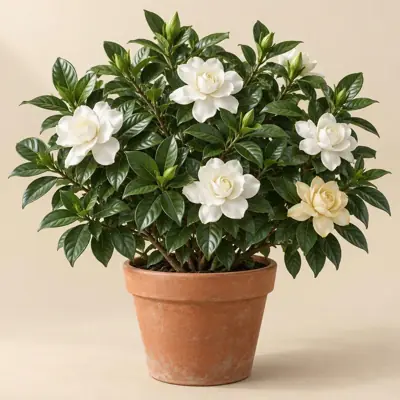
Overview
Gardenia jasminoides is an evergreen woody shrub, with some sources also describing a small-tree form; its growth can be dense and bushy. It is generally reported to be perennial.
Origin and habitat
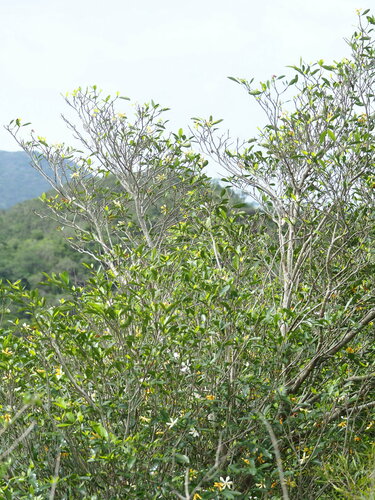
It is native to warm parts of East and Southeast Asia, with accounts including China, Japan, Taiwan, and Indochina; sources differ on whether the Korean Peninsula is also included. It can occur in mountain scrub, forests, along streams, on slopes and hills, in valleys, or in fields; Japanese records also describe growth from sunny to partly shaded settings. It is suited to warm tropical, subtropical, and warm-temperate environments and is often grown as an indoor or greenhouse plant in temperate regions.
Characteristics
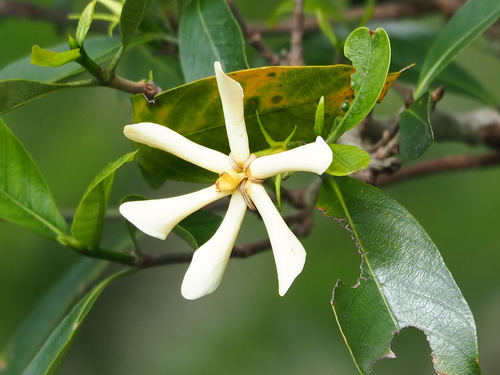
Sources differ on mature height, placing it at about 100–300 cm, while limited evidence reports a mature spread of about 100–150 cm. The leaves are usually opposite and sometimes whorled, leathery to nearly leathery, with shapes including oblong, elliptic, lanceolate, and obovate; they are glossy dark green with distinct veins. The strongly fragrant flowers are mainly white and gradually age to cream or pale yellow; they are broadly funnel-shaped or nearly funnel-shaped, with both single- and double-flowered horticultural forms. Sources differ on flowering time under cultivation, describing flowering from late spring into autumn in different climates; the fruit is generally reported as an ovoid to oblong berry that can mature to yellow, orange-yellow, or orange-red, sometimes with prominent longitudinal ribs and without splitting, while double-flowered forms often fail to fruit or form seed.
Light
Bright indirect light and conditions ranging from partial sun to partial shade are suitable; it can accept stronger sun but should be protected from intense exposure, with bright filtered light especially suitable for container plants.
Watering
It prefers moist but well-drained soil and wetter conditions in warm areas, although some sources also describe moderate drought tolerance; drying out in winter should be avoided.
Humidity and airflow
It is generally reported to prefer moderate humidity and need moderate airflow.
Temperature and dormancy
Sources differ, with limited evidence placing a minimum temperature at about 6 °C. It is generally reported to tolerate brief light frost.
Growing medium and mounting
It prefers fertile, organic-rich, moist but well-drained acidic soil; sources differ on the upper acceptable pH, and some horticultural sources also accept neutral soil.
Feeding
Fertilizer suitable for acid-loving plants can be used; nutrient deficiency during vigorous growth may cause older lower leaves to yellow, and horticultural sources recommend feeding during the growing season while avoiding autumn feeding that could stimulate frost-sensitive new growth.
Propagation
It can be propagated by seed, stem cuttings, softwood or semi-hardwood cuttings, layering, and grafting; Chinese-language sources also report that cuttings or air layering can root, while double-flowered forms that do not fruit cannot provide seed.
Common problems
Possible pests include whiteflies, aphids, thrips, scale insects, mealybugs, and some lepidopteran larvae, with larvae able to feed on flower buds or fruit. Poor airflow combined with hot, humid conditions can be associated with sooty mold, while greenhouse-grown plants can develop gray mold. Nutrient deficiency can cause yellowing beginning on older lower leaves; the root system is shallow and sensitive to root disturbance, and strong competition from tree roots should be avoided. It is sensitive to cold and strong winds, may suffer winter scorch, and should also be protected from intense sun; sheltered, frost-free conditions are recommended, with indoor protection when temperatures become sufficiently low.
Identification
Evergreen glossy dark green leaves combined with large, strongly fragrant white flowers that age to cream yellow form a conspicuous identifying combination.
Photos


Sources
- Wikipedia (en): Gardenia jasminoides — CC BY-SA 4.0 · link
- 維基百科:栀子 — CC BY-SA 4.0 · link
- Wikipedia (ja): クチナシ — CC BY-SA 4.0 · link
- Wikipedia (de): Gardenie — CC BY-SA 4.0 · link
- Wikipedia (fr): Gardenia jasminoides — CC BY-SA 4.0 · link
- GBIF descriptions: Arbolado urbano de Bogotá D.C asociado a servicios ambientales y culturales valorados como base de l — per dataset · link
- NC State Plant Toolbox: Gardenia jasminoides — copyright (facts only) · link
- TaiCOL 臺灣物種名錄: Gardenia jasminoides — CC BY 4.0 · link
- Useful Tropical/Temperate Plants: Gardenia jasminoides — CC BY-NC-SA 3.0 (facts only) · link
- RHS Plants: Gardenia jasminoides — © RHS, facts only · link
- USDA PLANTS Database: Gardenia jasminoides — Public domain (US Government work) · link
- Top Tropicals catalog: Gardenia jasminoides — © Top Tropicals LLC (facts only) · link