
hardy fuchsia (Fuchsia magellanica)
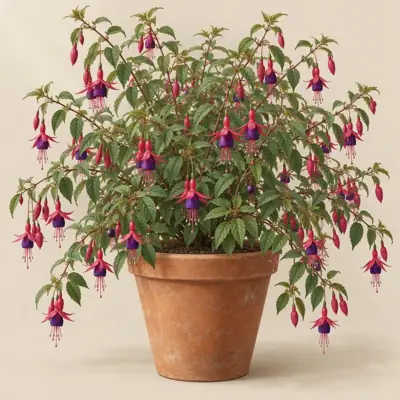
Fuchsia magellanica is a woody shrub with slender branches that can form an arching or fountain-like habit. Sources differ in describing its foliage: it is a perennial shrub, usually deciduous, but may be semi-evergreen in milder areas.
Overview
Fuchsia magellanica is a woody shrub with slender branches that can form an arching or fountain-like habit. Sources differ in describing its foliage: it is a perennial shrub, usually deciduous, but may be semi-evergreen in milder areas.
Origin and habitat
Sources differ somewhat on its native range, placing it in southern South America, principally Chile and Argentina, including Patagonia toward the Strait of Magellan. It commonly occurs in moist scrub, forest margins and clearings, especially near streams, waterways or marshy ground, although in high-rainfall areas of southern Chile it is not necessarily close to bodies of water. Its native environments are mainly temperate, cool and moist, with tolerance of some frost and a broad range of rainfall conditions.
Characteristics
Sources differ on mature height, giving a range of about 150–500 cm, while mature spread is 100–300 cm. Growth is generally reported as moderate, although a source also describes rapid development; leaves are reported to be ovate to lanceolate or elliptic, whorled or opposite, with toothed margins and short petioles that may be reddish. The pendent, axillary, bisexual flowers are slender and conspicuous, usually with red to magenta sepals and purple to blue-purple petals, with pink, pale purple or white forms also occurring; abundant flowering begins in summer and can continue until the first frost. The fruit is reported to be a fleshy, many-seeded, elliptic berry that can become black when ripe.
Light
It grows in full sun to partial shade, with horticultural sources also noting a preference for cool conditions with some shade.
Watering
It prefers cool, moist conditions and regular watering, with soil kept moist but well drained; some sources also report tolerance of waterlogging or varying moisture conditions.
Temperature and dormancy
Sources differ on the lower temperature limit, with limited evidence indicating about -10 °C. A source reports a USDA hardiness-zone range for the species. Fuchsia magellanica is frost hardy.
Growing medium and mounting
It suits fertile, humus-rich, well-drained soil and can adapt to clay; listed suitable soils also include chalk, loam and sand, across acidic, neutral or alkaline conditions.
Common problems
It is reported to be susceptible to aphids, spider mites and whiteflies. In cold conditions, above-ground growth may die back after frost; when escaped from cultivation, it can form dense stands in some areas and suppress native vegetation. It is relatively tolerant of cold and salt-laden coastal winds, but severe frost can kill above-ground growth, while young spring shoots remain frost-sensitive.
Identification
Fuchsia magellanica can be recognized by slender, pendent red-purple flowers, elongated ovaries and fruits, relatively long petioles, conspicuously toothed leaf margins, and an often arching shrub habit.
Photos


Sources
- Wikipedia (en): Fuchsia magellanica — CC BY-SA 4.0 · link
- Wikipedia (de): Scharlach-Fuchsie — CC BY-SA 4.0 · link
- Wikipedia (fr): Fuchsia de Magellan — CC BY-SA 4.0 · link
- Wikipedia (es): Fuchsia magellanica — CC BY-SA 4.0 · link
- GBIF descriptions: Lista de especies de plantas exóticas y trasplantadas de Colombia; Catálogo de Plantas y Líquenes de — per dataset · link
- NC State Plant Toolbox: Fuchsia magellanica — copyright (facts only) · link
- Wikipedia (nl): Fuchsia magellanica — CC BY-SA 4.0 · link
- Wikipedia (pt): Fuchsia magellanica — CC BY-SA 4.0 · link
- Useful Tropical/Temperate Plants: Fuchsia magellanica — CC BY-NC-SA 3.0 (facts only) · link
- RHS Plants: Fuchsia magellanica — © RHS, facts only · link
- USDA PLANTS Database: Fuchsia magellanica — Public domain (US Government work) · link
- Top Tropicals catalog: Fuchsia magellanica — © Top Tropicals LLC (facts only) · link