
fissidens moss (Fissidens fontanus)
Fissidens fontanus is an aquatic, pleurocarpous, non-vascular moss that can form mats, with leaves arranged in rows along the stem in a fern-like pattern. It is reported to be long-lived.
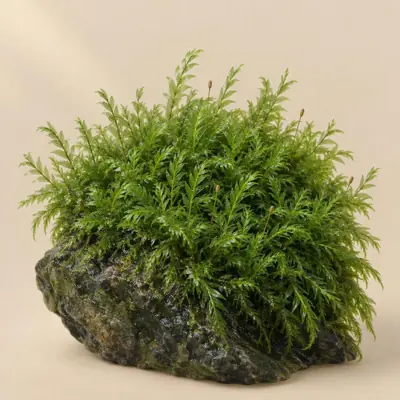
Overview
Fissidens fontanus is an aquatic, pleurocarpous, non-vascular moss that can form mats, with leaves arranged in rows along the stem in a fern-like pattern. It is reported to be long-lived.
Origin and habitat
Sources differ on its native range: it is described as widespread in Europe, including Macaronesia, the Mediterranean region, North Africa, Southwest Asia, North America, and Central America; USDA lists it as native to North America, and its occurrence in Chile has also been documented. It grows mainly underwater or in persistently wet environments, including rivers, lakes, canals, fountain basins, riverbeds, irrigation channels, and weirs; it favors slow-flowing or still water but can be briefly exposed where water levels vary seasonally. It can attach to bedrock, stones, walls, tree roots, wood, and metal, and is associated with both flowing and still water as well as nutrient-rich waters.
Characteristics
A source reports a mature height of about 0–3 cm; sources are few. The leaves are narrow and elongated to lance-shaped, with a prominent midrib, arranged in rows and spaced along the stem; the leaf base has a folded, pocket-like lobe, and leaves may appear clustered near the tip. When dry, the leaves curl inward and become wavy.
Watering
It is reported to require aquatic or very wet conditions and to suit continuous submersion, slow-flowing water, or still water; it does not tolerate drying.
Humidity and airflow
It generally prefers high humidity.
Common problems
It is reported to be eaten by aquatic mollusks and black swans. Drying is reported to be a clear risk; after water loss, it dries rapidly, with leaves curling inward and becoming wavy. It is reported not to tolerate drying and is adapted to aquatic or highly humid environments; prolonged exposure as water levels fall may cause drying stress.
Identification
Typical identifying features include leaves arranged in rows, a folded pocket-like portion at the leaf base, and leaves spaced along the stem. The sporophytes are borne on the stem, often at the leaf bases, with short capsules held upright and outward.
Sources
- Wikipedia (en): Fissidens fontanus — CC BY-SA 4.0 · link
- Wikipedia (de): Echter Quellgabelzahn — CC BY-SA 4.0 · link
- GBIF descriptions: Validated red lists of Flanders, Belgium; New bryophytes for Tunisia (North Africa). Part 2: other f — per dataset · link
- USDA PLANTS Database: Fissidens fontanus — Public domain (US Government work) · link