
Chinese banyan (Ficus microcarpa)
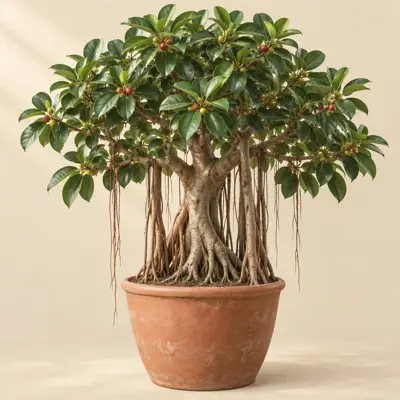
Ficus microcarpa is a perennial evergreen that grows as a large tree, while potted plants can retain a shrub-like or small-tree form; mature plants often develop a broad crown and abundant aerial roots.
Overview
Ficus microcarpa is a perennial evergreen that grows as a large tree, while potted plants can retain a shrub-like or small-tree form; mature plants often develop a broad crown and abundant aerial roots.
Origin and habitat
Sources differ on the native range, describing it as extending across South Asia, East Asia, and Southeast Asia, including the Indian subcontinent, southern China, Taiwan, southern Japan, and Southeast Asia, and eastward to western Pacific islands and from northern Australia toward Queensland. Its diverse natural habitats include tropical rainforest, evergreen broadleaf forest, riverbanks, coasts, swamps, areas near mangroves, limestone hills, and other environments from lowlands to mountains; it can also grow as an epiphyte on other trees or on substrates such as rocks. It occurs in tropical to subtropical climates and prefers warm, humid conditions; it has some tolerance of low temperatures but is unsuited to frost.
Characteristics
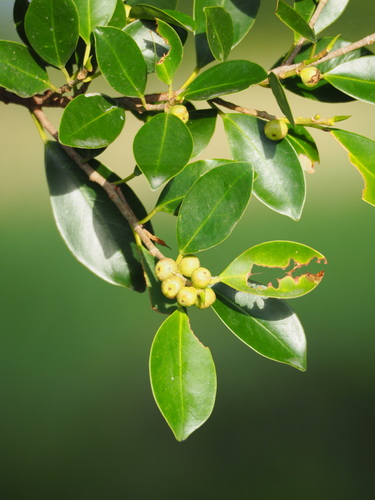
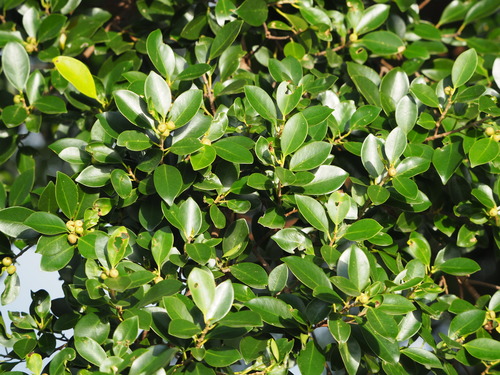
Mature height is reported at about 1500–2500 cm, but sources differ; a mature spread of about 1219 cm is reported from few sources. Growth is rapid, and the alternate, leathery, hairless leaves are generally elliptic to obovate, glossy dark green, and entire-margined, although sources differ in their descriptions of leaf size. Sources differ in describing the very small flowers, which occur inside fig-like enclosed inflorescences borne in leaf axils or on branches; a single source reports flowering through nearly the whole year. The small, nearly spherical to ovoid figs change from green to yellow, pale red, or red as they mature, and can be eaten by birds and other animals that disperse the seeds.
Light
Ficus microcarpa prefers full sun to bright filtered light and can adapt to partial shade; it has some shade tolerance, but insufficient light can cause elongated growth, while excessively strong direct summer light can scorch the leaves.
Watering
During active growth, keep the soil moist but well drained; from spring through autumn, water thoroughly after the surface soil dries, while some horticultural sources more generally describe moderate watering after the surface dries.
Humidity and airflow
Ficus microcarpa prefers high humidity.
Temperature and dormancy
Sources differ on the minimum temperature, with few sources indicating about 0 °C. A single source reports a USDA hardiness-zone classification. It is frost tender; keep above freezing.
Growing medium and mounting
It prefers fertile, moist but well-drained soil and can adapt to chalky, clay, loam, or sandy soils and to acidic, neutral, or alkaline media. For greenhouse container culture, a loam-based, peat-free growing medium can be used.
Feeding
A single source reports feeding during the spring-to-autumn growing period with a slow-release fertilizer applied periodically.
Propagation
Ficus microcarpa can be propagated from seed, leaf-bud cuttings, or semi-hardwood cuttings; sources also record propagation by cuttings more generally.
Common problems
Indoor or greenhouse plants may be affected by spider mites, thrips, mealybugs, and scale insects, with Cuban laurel thrips and other pests also recorded. Insufficient indoor light can cause elongated growth, while strong summer sunlight can cause leaf scorch; outdoors, aerial roots and the root system can damage paving or concrete structures. It is sensitive to frost and freezing; although it has some cold tolerance and can briefly experience temperatures near freezing, it is unsuited to frost exposure, and growing sites should also be sheltered from strong winds.
Identification
Branches produce abundant hanging aerial roots that can thicken after reaching the soil and form prop roots, eventually becoming trunk-like. Other distinguishing features include a broad crown, small leathery glossy leaves, and milky sap, and the plant may begin growth as an epiphyte.
Photos


Sources
- Wikipedia (en): Ficus microcarpa — CC BY-SA 4.0 · link
- 維基百科:正榕 — CC BY-SA 4.0 · link
- Wikipedia (ja): ガジュマル — CC BY-SA 4.0 · link
- Wikipedia (de): Chinesische Feige — CC BY-SA 4.0 · link
- Wikipedia (es): Ficus microcarpa — CC BY-SA 4.0 · link
- NC State Plant Toolbox: Ficus microcarpa — copyright (facts only) · link
- Wikipedia (it): Ficus microcarpa — CC BY-SA 4.0 · link
- TaiCOL 臺灣物種名錄: Ficus microcarpa — CC BY 4.0 · link
- Useful Tropical/Temperate Plants: Ficus microcarpa — CC BY-NC-SA 3.0 (facts only) · link
- RHS Plants: Ficus microcarpa — © RHS, facts only · link
- USDA PLANTS Database: Ficus microcarpa — Public domain (US Government work) · link
- Top Tropicals catalog: Ficus microcarpa — © Top Tropicals LLC (facts only) · link