
Indian rubberplant (Ficus elastica)
Ficus elastica is a large evergreen tree and a perennial evergreen woody plant. In the wild it can form aerial roots, prop roots, or buttress roots and may grow as a strangling hemiepiphyte; in temperate regions it is commonly grown as a large indoor foliage plant.
Overview
Ficus elastica is a large evergreen tree and a perennial evergreen woody plant. In the wild it can form aerial roots, prop roots, or buttress roots and may grow as a strangling hemiepiphyte; in temperate regions it is commonly grown as a large indoor foliage plant.
Origin and habitat
Sources differ on the native range, describing Ficus elastica as native from southern Asia into Southeast Asia, with a core range including Nepal, Bhutan, northeastern India, Bangladesh, Myanmar, Thailand, Yunnan in China, Malaysia, and Indonesia, while some sources summarize the range as extending from the eastern Himalayas to northern Malaysia. It occurs in tropical forests, including montane forests, cliffs, and limestone hills, and can begin growing epiphytically on the branches or trunks of other trees. It is native to tropical to humid, hot Asian environments and is also widely grown outdoors as an ornamental tree in tropical and subtropical climates; in colder temperate climates it is usually grown indoors.
Characteristics
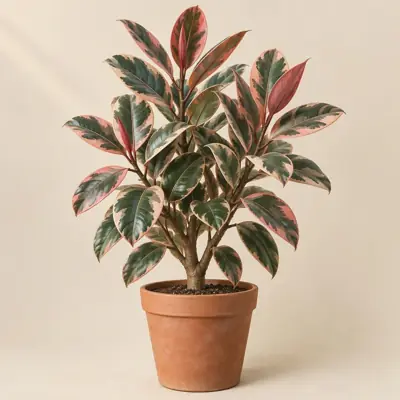
Sources differ on mature height, with the few available sources giving about 250–400 cm; mature spread is generally reported at about 100–150 cm, based on few sources. The leaves are large, simple, entire, thick, leathery, and glossy, ranging from elongated elliptic to broadly ovate; leaves on young plants can be larger, while those on older trees are often noticeably smaller, and new leaves develop within a sheath-like structure whose outer sheath falls away after they unfold. The flowers are borne inside fig-like inflorescences and depend on specific fig wasps for pollination; they do not attract general pollinators with bright colors or strong fragrance, and flowering is rare indoors. Flowering is reported to occur during part of the year, while sources differ in describing the fruit as small and oval, becoming yellow-green when mature and readily producing viable seed only where suitable pollinating fig wasps occur.
Light
Sources differ somewhat on light requirements, describing bright indirect light to partial sun and tolerance of lower light levels. Young or indoor plants should not be suddenly exposed to strong direct summer or afternoon sun because this can increase the risk of leaf scorch.
Watering
During active growth, water regularly and moderately, allowing the surface of the growing medium to dry slightly before watering thoroughly while avoiding overwatering or waterlogging; reduce watering in winter or during dormancy.
Humidity and airflow
Ficus elastica is generally reported to prefer moderate humidity and need little air movement.
Temperature and dormancy
Sources differ on the lower temperature, with the few available sources indicating about 13 °C. It is generally reported to be frost tender and should be kept above freezing. Its hardiness is generally described using a USDA zone range.
Growing medium and mounting
For containers, use a well-drained growing medium; a loam-based medium is also described as suitable, with moist but well-drained conditions and acidic, neutral, or alkaline media all acceptable.
Feeding
Sources differ on feeding details, but describe regular fertilizing during active growth; one recommendation favors a high-nitrogen fertilizer, while another describes liquid fertilizer from spring through autumn.
Propagation
Ficus elastica can be propagated by cuttings or by air layering or layering; for air layering, a stem wound can be treated for rooting and wrapped with moist sphagnum moss, then separated and planted after roots form.
Common problems
Potential pests include mealybugs, scale insects, thrips, and greenhouse red spider mites; problems associated with Armillaria and root rot may also occur. Overwatering and excessive fertilizing should be avoided; insufficient light can cause elongated growth reaching toward the light, while plants in favorable container conditions can quickly become large or root-bound. Ficus elastica is sensitive to frost and low temperatures and does not favor cold winds or drafts; strong direct summer or afternoon sun can cause leaf scorch.
Identification
Ficus elastica can be recognized by its large, glossy, leathery leaves, sheath-like stipules around new leaves, and white latex released when injured; large wild plants can develop aerial roots as well as prop or buttress roots.
Photos



Sources
- Wikipedia (en): Ficus elastica — CC BY-SA 4.0 · link
- 維基百科:印度榕 — CC BY-SA 4.0 · link
- Wikipedia (ja): インドゴムノキ — CC BY-SA 4.0 · link
- Wikipedia (de): Gummibaum — CC BY-SA 4.0 · link
- Wikipedia (fr): Ficus elastica — CC BY-SA 4.0 · link
- Wikipedia (es): Ficus elastica — CC BY-SA 4.0 · link
- GBIF descriptions: Checklist of introduced taxa in Cyprus; Especies de arbolado urbano y sus medidas de captura y almac — per dataset · link
- NC State Plant Toolbox: Ficus elastica — copyright (facts only) · link
- Wikipedia (it): Ficus elastica — CC BY-SA 4.0 · link
- Wikipedia (pt): Ficus elastica — CC BY-SA 4.0 · link
- TaiCOL 臺灣物種名錄: Ficus elastica — CC BY 4.0 · link
- Useful Tropical/Temperate Plants: Ficus elastica — CC BY-NC-SA 3.0 (facts only) · link
- RHS Plants: Ficus elastica — © RHS, facts only · link
- USDA PLANTS Database: Ficus elastica — Public domain (US Government work) · link