
African fig tree (Ficus cyathistipula)
Ficus cyathistipula is an evergreen woody plant that may grow as a small tree, shrub, or semi-epiphytic climber, while cultivated plants may have a more clumping habit.
Overview
Ficus cyathistipula is an evergreen woody plant that may grow as a small tree, shrub, or semi-epiphytic climber, while cultivated plants may have a more clumping habit.
Origin and habitat
Ficus cyathistipula is native to tropical Africa, from Côte d'Ivoire east to western Kenya and northern Malawi, with southern records from northern Angola, northern Zambia, and Mount Namuli in Zambezia Province, Mozambique. It is reported from moist tropical African montane forest and rainforest, as well as forest streams, riversides, swamps, above pools, inselbergs, and rocky outcrops.
Characteristics
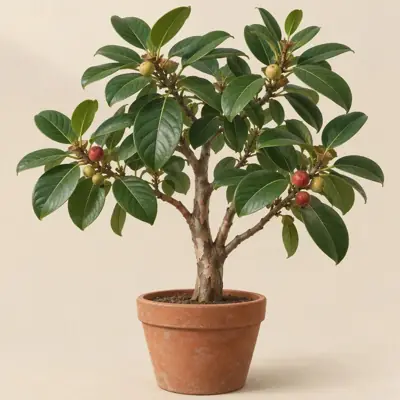
Sources differ on mature height, placing it at about 100–150 cm. A source reports a mature spread of about 50–100 cm. The leaves are reported to be dark, hairless, and leathery, ranging from ovate to oblanceolate, usually with a blunt tip, lateral veins, a spiral arrangement, and a petiole. The fig fruits are reported to be nearly spherical, solitary or clustered in the leaf axils, stalked or nearly stalkless, greenish yellow to white with pale yellow spots when young and red when mature, with a thick, spongy wall.
Light
It is reported to grow in full sun to partial sun; indoors, it can be placed in bright light or bright filtered light.
Watering
The growing medium is generally kept moist but well drained, with moderate watering during the growing period and reduced watering in winter.
Temperature and dormancy
It is reported as RHS H1A and frost tender; keep above freezing.
Growing medium and mounting
It is reported to grow in houseplant potting mix or loam and in moist but well-drained media with acidic, neutral, or alkaline pH.
Feeding
A high-nitrogen fertilizer is generally applied monthly during the growing period.
Propagation
It is reported to be propagated from semi-hardwood cuttings in spring or summer using bottom heat.
Common problems
In greenhouse or indoor cultivation, it is reported to be susceptible to spider mites, thrips, mealybugs, and scale insects. It is reported to be susceptible to honey fungus disease and is generally grown in a sheltered position.
Identification
It is reported to have cup-shaped, persistent stipules and thick, leathery leaves; the mature figs are red, with thick, spongy walls that allow the fruit to float on water.
Photos

