
weeping fig (Ficus benjamina)
Ficus benjamina is a perennial evergreen broadleaf shrub or tree that can become a large tree in natural settings and is also commonly grown indoors as a potted foliage plant.
Overview
Ficus benjamina is a perennial evergreen broadleaf shrub or tree that can become a large tree in natural settings and is also commonly grown indoors as a potted foliage plant.
Origin and habitat
Sources differ on the native range, describing it broadly from Asia to Australia and the southwestern Pacific, including South Asia, Southeast Asia, southern China, the Malay Archipelago, New Guinea, northern Australia, and some Pacific islands. It occurs in moist mixed forests, mixed forests near villages, low- to mid-elevation primary forests, and along rivers and streams. It is suited to tropical, subtropical, and warm frost-free environments and does not tolerate cold well.
Characteristics
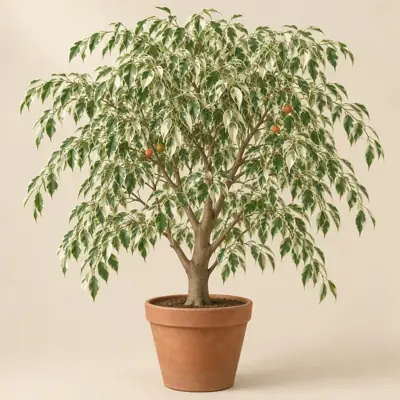
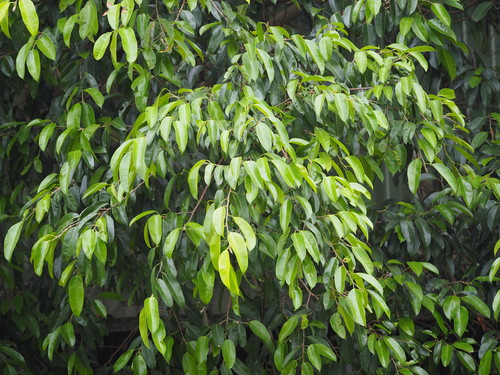
Sources differ on mature height, placing it at about 1500–3000 cm, while mature spread is 760–1000 cm. It is reported to show sustained, noticeable growth during the warm season, beginning new growth in spring and potentially continuing into autumn; hot periods are also reported as suitable for propagation and care. The leaves are simple, entire, stalked, glossy, and ovate to ovate-lanceolate or ovate-elliptic with tapering tips; young leaves are lighter green, and 'Starlight' is a variegated cultivar. The plant is monoecious, with green, spherical to ovoid syconia containing male flowers, fertile female flowers, and sterile female flowers; the flowers are generally inconspicuous ornamentally, while sources differ in their descriptions of the fruit, which is reported to mature from orange to orange-red and, in another account, from red-orange to black.
Light
Sources differ somewhat on light conditions: bright conditions are preferred, with full sun, partial sun, or bright indirect light described as acceptable, while bright filtered light is especially suitable indoors. Variegated plants may develop leaf scorch if suddenly exposed to strong direct sun and are best acclimated gradually.
Watering
From spring through autumn, water thoroughly after the surface of the growing medium dries, maintaining regular moisture without prolonged wetness; in winter, reduce watering and allow the medium to become somewhat drier without drying out completely.
Humidity and airflow
It is generally reported to prefer high humidity and needs little air movement.
Temperature and dormancy
From the few available reports, the preferred temperature is about 20–25 °C, with about 10 °C reported as a minimum. A USDA hardiness-zone rating is reported, and Ficus benjamina is frost tender; keep above freezing.
Growing medium and mounting
Use a well-drained growing medium; soil-based potting medium or loam-based peat-free compost can be used, while outdoors it can adapt to clay, loam, sand, and chalk soils, with sources supporting acidic, neutral, and alkaline conditions.
Feeding
Sources differ on feeding guidance, but feeding is described from early summer to early autumn using a slow-release fertilizer.
Propagation
It can be propagated by cuttings and layering, while some sources also list seed, leaf-bud cuttings, or semi-ripe cuttings. Cuttings are convenient when branches are slender, and the hot period in early summer is described as easy to manage for rooting.
Common problems
It is reported to be susceptible to pests including two-spotted spider mites, thrips, aphids, and scale insects. Leaf drop may follow a sudden change in light after the plant is moved, overly wet growing medium in cold conditions, or low air humidity; variegated plants may develop leaf scorch after sudden exposure to strong direct light. It does not tolerate cold, frost, or cold winds well; avoid low temperatures, and outdoor cultivation should be in a frost-free, sheltered environment.
Identification
Ficus benjamina has gracefully drooping branches and relatively small, glossy leaves; 'Starlight' is distinguished by its variegated foliage.
Photos



Sources
- Wikipedia (en): Ficus benjamina — CC BY-SA 4.0 · link
- 維基百科:垂榕 — CC BY-SA 4.0 · link
- Wikipedia (ja): ベンジャミン (植物) — CC BY-SA 4.0 · link
- Wikipedia (de): Birkenfeige — CC BY-SA 4.0 · link
- Wikipedia (fr): Ficus benjamina — CC BY-SA 4.0 · link
- Wikipedia (es): Ficus benjamina — CC BY-SA 4.0 · link
- GBIF descriptions: Checklist of introduced taxa in Cyprus; Captura y almacenamiento de carbono en el arbolado del Jardí — per dataset · link
- NC State Plant Toolbox: Ficus benjamina — copyright (facts only) · link
- Wikipedia (it): Ficus benjamina — CC BY-SA 4.0 · link
- Wikipedia (nl): Waringin — CC BY-SA 4.0 · link
- TaiCOL 臺灣物種名錄: Ficus benjamina — CC BY 4.0 · link
- Useful Tropical/Temperate Plants: Ficus benjamina — CC BY-NC-SA 3.0 (facts only) · link
- RHS Plants: Ficus benjamina — © RHS, facts only · link
- USDA PLANTS Database: Ficus benjamina — Public domain (US Government work) · link