
Indian banyan (Ficus benghalensis)
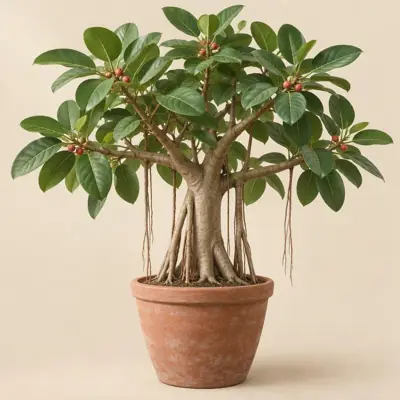
Ficus benghalensis is a large perennial evergreen tree with a broad, spreading crown. It often begins growth as an epiphyte and develops numerous hanging aerial roots and prop roots.
Overview
Ficus benghalensis is a large perennial evergreen tree with a broad, spreading crown. It often begins growth as an epiphyte and develops numerous hanging aerial roots and prop roots.
Origin and habitat
Ficus benghalensis is native to the Indian subcontinent; sources differ on the more specific range, listing India, Pakistan, Nepal, the eastern Himalayas and Sri Lanka, with some also listing Bangladesh. Its habitats include tropical and subtropical forests, including monsoon forest, rainforest, and lowland evergreen to deciduous forest, and in nature it often begins growth as an epiphyte on other trees. It occurs in humid tropical to subtropical climates, and mature plants have some drought tolerance.
Characteristics
Sources differ on mature height, placing it at about 2000–3000 cm. Growth is fast, and the leaves are large, thick and leathery, ranging from ovate or broadly ovate to elliptic; young leaves may be red or bronze, while mature leaves are dark green with paler veins. The flowers are inconspicuous, with the small Ficus flowers enclosed within the hollow inflorescence structure that forms the fruit. The small, round fig fruits may occur in pairs and become bright red to coral red when mature.
Light
Sources differ in describing its light conditions: indoors it is grown in bright filtered or bright indirect light, while the species can also receive full sun in more open settings.
Watering
During growth, water moderately and keep the growing medium moist but well drained; indoors, allow the surface layer to dry before watering again.
Temperature and dormancy
Sources are few and differ on the lower temperature, placing it at about 15 °C. A single source reports an upper temperature of about 40 °C.
Growing medium and mounting
Use a moist but well-drained growing medium; indoors, suitable options include a quality potting medium with perlite or a peat-free loam-based medium with bark. It can adapt to acidic, neutral and alkaline conditions.
Propagation
Ficus benghalensis can be propagated by seed or cuttings. RHS recommends soaking seed before sowing in spring, or taking semi-ripe cuttings in spring or summer with bottom heat.
Common problems
As a tropical plant, mature Ficus benghalensis can tolerate some drought and light frost, while indoor and greenhouse horticultural guidance recommends maintaining a minimum temperature in a warm range.
Identification
Its branches spread widely and continually produce hanging aerial roots; after reaching the ground, these roots take root, thicken and become woody, forming secondary trunks that support the crown and allow a single tree to continue spreading laterally. In nature, it commonly has a strangler-fig growth habit.
Photos


Sources
- Wikipedia (en): Ficus benghalensis — CC BY-SA 4.0 · link
- 維基百科:孟加拉榕 — CC BY-SA 4.0 · link
- Wikipedia (ja): ベンガルボダイジュ — CC BY-SA 4.0 · link
- Wikipedia (de): Banyan-Feige — CC BY-SA 4.0 · link
- Wikipedia (fr): Figuier des banians — CC BY-SA 4.0 · link
- Wikipedia (es): Ficus benghalensis — CC BY-SA 4.0 · link
- GBIF descriptions: Lista de especies de plantas exóticas y trasplantadas de Colombia; Catálogo de Plantas y Líquenes de — per dataset · link
- NC State Plant Toolbox: Ficus benghalensis — copyright (facts only) · link
- Useful Tropical/Temperate Plants: Ficus benghalensis — CC BY-NC-SA 3.0 (facts only) · link
- RHS Plants: Ficus benghalensis — © RHS, facts only · link
- USDA PLANTS Database: Ficus benghalensis — Public domain (US Government work) · link