
council tree (Ficus altissima)
Ficus altissima is a large evergreen tree that often begins growth in the wild as a hemiepiphyte or epiphyte, later forming supporting roots, and it can also be cultivated as a foliage plant. Sources differ in describing its life cycle; it is described as perennial.
Overview
Ficus altissima is a large evergreen tree that often begins growth in the wild as a hemiepiphyte or epiphyte, later forming supporting roots, and it can also be cultivated as a foliage plant. Sources differ in describing its life cycle; it is described as perennial.
Origin and habitat
Ficus altissima is native to tropical and subtropical parts of Asia, with sources commonly including southern China, India, Myanmar, Thailand, Vietnam, and the Malay Archipelago; some sources also include Bhutan, Nepal, Laos, the Andaman Islands, Malaysia, Indonesia, the Philippines, and Pacific islands. It occurs in lowland to montane forests, on plains and in mountainous areas, and may begin as an epiphyte on trees or establish in crevices in rocks, walls, buildings, or other structures. It prefers sunny, hot, humid tropical to subtropical environments, while its distribution includes both lowland and montane settings.
Characteristics
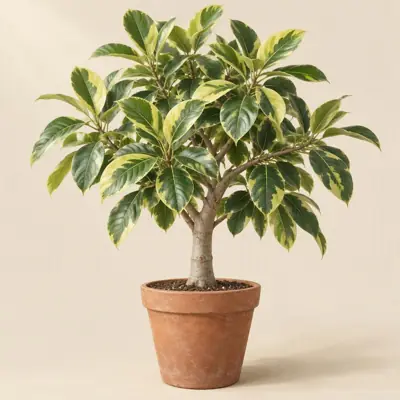
Sources differ on mature height, with the limited information placing it at about 3000–3000 cm. A single source reports a mature spread of about 3048–3048 cm, so sources are few. It is reported to grow quickly and to have alternate, simple, elliptic to ovate, entire, thick and leathery leaves with conspicuous veins beneath; the cultivar 'Yellow Gem' has yellow-toned variegation. The flowers are reported to be concealed within fig-like enclosed inflorescences and not readily visible externally, with inflorescences occurring singly or in pairs in the leaf axils; the plant is monoecious, can flower and fruit multiple times in a year, and after pollination forms many-seeded figs whose mature or later-stage color is variously described by sources as golden yellow, orange-red, or red.
Light
Sources differ: Ficus altissima prefers bright, sunny positions and can be placed by a well-lit window indoors, although strong direct summer sun may scorch the leaves, while another horticultural source recommends partial sun.
Watering
It is reported to benefit from thorough watering after the surface soil dries from spring through autumn, with reduced watering in winter to keep it somewhat dry without excessive drying; another source broadly recommends moderate watering when the surface soil is dry.
Humidity and airflow
It is reported to prefer high humidity.
Temperature and dormancy
A single source reports a USDA hardiness zone designation for Ficus altissima. It is generally frost tender; keep above freezing.
Feeding
It is reported to benefit from slow-release fertilizer from spring through autumn at regular intervals.
Propagation
It is reported that indoor plants can be maintained through vegetative propagation by cuttings or air layering, while normal sexual reproduction is difficult indoors without the specific fig-wasp pollination system.
Common problems
Scale insects may occur, while horticultural information for the genus Ficus also notes spider mites and mealybugs. A single source reports that the genus Ficus may develop anthracnose, bacterial diseases, and root rot. Strong direct summer sunlight may scorch the leaves, while mature outdoor plants have extensive roots and become very large, making them unsuitable for most confined urban spaces. It is sensitive to frost and should be kept from freezing conditions; strong direct summer sunlight may also scorch the leaves.
Identification
Ficus altissima is reported to have a broad-spreading crown, smooth gray bark, aerial roots and buttress roots, and young twigs that may be hairy; broken branches exude white latex, while 'Yellow Gem' is chiefly distinguished horticulturally by its yellow-toned variegated leaves.
Photos


Sources
- Wikipedia (en): Ficus altissima — CC BY-SA 4.0 · link
- 維基百科:高山榕 — CC BY-SA 4.0 · link
- Wikipedia (ja): フィカス・アルティシマ — CC BY-SA 4.0 · link
- Wikipedia (es): Ficus altissima — CC BY-SA 4.0 · link
- Wikipedia (nl): Ficus altissima — CC BY-SA 4.0 · link
- Useful Tropical/Temperate Plants: Ficus altissima — CC BY-NC-SA 3.0 (facts only) · link
- USDA PLANTS Database: Ficus altissima — Public domain (US Government work) · link
- Top Tropicals catalog: Ficus altissima — © Top Tropicals LLC (facts only) · link