
Devil's Tongue Barrel Cactus (Ferocactus latispinus)
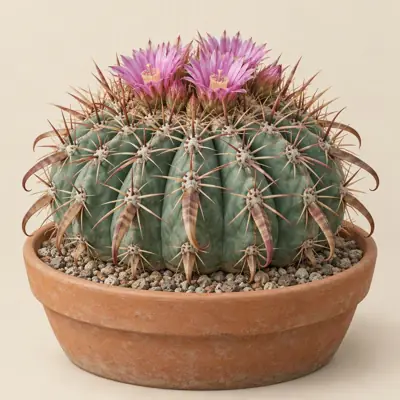
Ferocactus latispinus is an evergreen perennial succulent with a globular, barrel-like stem that is usually solitary and does not branch or produce offsets; sources differ in their descriptions of its habit.
Overview
Ferocactus latispinus is an evergreen perennial succulent with a globular, barrel-like stem that is usually solitary and does not branch or produce offsets; sources differ in their descriptions of its habit.
Origin and habitat
Ferocactus latispinus is native and endemic to Mexico, occurring mainly in central areas and extending into some northern and southern areas; reported states include Zacatecas, Aguascalientes, San Luis Potosí, Hidalgo, Puebla, Jalisco, Guanajuato, Querétaro, Estado de México, and Oaxaca, while sources differ over records from Durango. It occurs in arid habitats including xeric scrub, grassland, silty flats, rocky outcrops or slopes, and open oak woodland, and can also grow beneath sheltering shrubs or tree canopies. Its habitat is dry and strongly sunlit, with dry scrub and grassland predominating across its range.
Characteristics
Sources differ on mature height, reporting about 10–40 cm, while mature spread is 25–45 cm. Flowers arise near the top of the plant, are funnel-shaped to bell-shaped, and may be pink, reddish purple, purple, or yellow. Flowering occurs from late autumn into early winter, with horticultural sources also recording winter flowering. Sources differ in describing the scaled fruit, which ranges in shape from ovoid or globular to elongated.
Light
Ferocactus latispinus takes full sun, and abundant bright sunlight helps promote flower formation.
Watering
Water moderately during the growing season; in winter, provide little water to almost none and keep the growing medium well drained.
Humidity and airflow
It is generally reported to prefer low humidity and need good airflow.
Temperature and dormancy
Sources differ on the lower temperature limit, with about -4 °C reported as a minimum. It tolerates brief light frost, is frost hardy, and has a cold minimum of -4 °C. It rests cool and dry in winter.
Growing medium and mounting
Use a well-drained cactus growing medium; loamy or sandy media can be used, with coarse sand or gravelly material added to improve drainage, and the plant can adapt to acidic, neutral, or alkaline media. It needs a fast-draining mix.
Feeding
It is generally reported to need feeding only during the growing season, using fertilizer intended for cacti or succulents.
Propagation
Propagate by seed; RHS recommends sowing in spring.
Common problems
Mealybugs are reported as a possible pest. Excess watering is reported to cause stem and root rot, while overly wet growing medium and excessive winter moisture are major cultivation risks associated with rot. In cold conditions it should be kept dry; it prefers sunny, dry, well-drained conditions and does not tolerate prolonged winter wetness.
Identification
Sources differ in their descriptions, but Ferocactus latispinus is usually solitary and pale green to blue-green, with conspicuous ribs and stout central and radial spines. The lowest central spine is especially broad and flattened and is often curved downward or hooked; spine color ranges from red and yellowish brown to white.
Photos


Sources
- Wikipedia (en): Ferocactus latispinus — CC BY-SA 4.0 · link
- Wikipedia (de): Ferocactus latispinus — CC BY-SA 4.0 · link
- Wikipedia (fr): Ferocactus latispinus — CC BY-SA 4.0 · link
- Wikipedia (es): Ferocactus latispinus — CC BY-SA 4.0 · link
- LLIFLE Encyclopedia of living forms: Ferocactus latispinus — CC BY-SA · link
- Useful Tropical/Temperate Plants: Ferocactus latispinus — CC BY-NC-SA 3.0 (facts only) · link
- RHS Plants: Ferocactus latispinus — © RHS, facts only · link
- Desert-Tropicals: Ferocactus latispinus — © Philippe Faucon (desert-tropicals.com), facts only · link
- NC State Plant Toolbox: Ferocactus (genus-level) — copyright (facts only) · link
- PUKUBOOK: Ferocactus latispinus — CC BY-NC (facts only) · link
- Ferocactus latispinus: Complete care guide, characteristics, and growing tips (en.jardineriaon.com) — facts only (§12) · link
- Ferocactus / RHS Plant Guide (www.rhs.org.uk) — facts only (§12) · link
- Ferocactus latispinus | Giromagi.com | Giromagi cactus and succulents for sale | (www.giromagi.com) — facts only (§12) · link