
centipede tongavine (Epipremnum pinnatum)
Sources differ in describing Epipremnum pinnatum as an evergreen perennial climbing vine that attaches to trunks, rocks, or supports with aerial roots and may begin on the ground before becoming semi-epiphytic or epiphytic. It is a perennial.
Overview
Sources differ in describing Epipremnum pinnatum as an evergreen perennial climbing vine that attaches to trunks, rocks, or supports with aerial roots and may begin on the ground before becoming semi-epiphytic or epiphytic. It is a perennial.
Origin and habitat
Sources differ on details of its broad native range, which extends through tropical Asia to the western Pacific, including India and neighboring South Asia, Southeast Asia, southern China, Taiwan, the Ryukyu Islands of Japan, the Philippines, the Malay Archipelago, New Guinea, Melanesia, and northern Australia; Taiwan's species list treats it as native to Taiwan. Sources differ in their habitat accounts, but it occurs mainly in forests, where aerial roots attach to trunks and rock faces in rainforests or mountain forests; it may also occur in disturbed areas and along roadsides, and can climb from the ground toward the forest canopy while gradually losing its direct connection to the ground. It is a plant of tropical to warm environments, preferring warmth and some humidity and being sensitive to frost and cold.
Characteristics
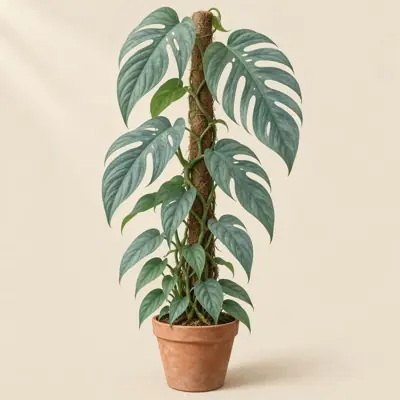
Sources differ, with limited evidence, on mature height, reporting about 250–400 cm. Limited evidence reports a mature spread of about 50–100 cm. The leaves show marked differences between growth stages: juvenile leaves are entire and may be narrowly ovate, ovate-elliptic, elliptic, or arrow-shaped, while mature leaves become substantially larger and thicker with deep pinnate divisions; 'Cebu Blue' has pale gray-blue to blue foliage, with the blue tone becoming more evident under suitable light. It produces a spadix and spathe with densely arranged, bisexual flowers lacking a perianth, and the inflorescence and spathe may have white-green, creamy white, or yellow-green tones; it also forms berries, although sources differ on whether mature fruit is described as green or as red with sticky flesh, and flowering is reported to occur in late spring to early summer.
Light
Bright indirect light to partial shade is suitable, and the species can also grow in shadier conditions; indoors, bright filtered light matches the main horticultural recommendations.
Watering
Keep the growing medium moist but well drained, avoiding standing water after watering; allow the surface or the medium just below it to dry partly before watering again, and keep it somewhat drier in winter than during the growing season.
Humidity and airflow
It is generally reported to prefer moderate humidity.
Temperature and dormancy
Sources differ on the reported hardiness zone. It is generally described as frost tender; keep above freezing.
Growing medium and mounting
Use an airy, moisture-retentive but porous and well-drained potting medium, preferably rich in organic matter; one source recommends slightly acidic conditions, while another reports adaptation to acidic, neutral, or alkaline media. Epipremnum pinnatum has aerial and soil roots.
Feeding
Fertilizer may be applied regularly during the growing season; sources describe approaches using balanced liquid fertilizer or either slow-release or liquid fertilizer.
Propagation
Propagation can be by stem cuttings, tip cuttings, or layering, and cuttings should include a node; one source reports that rooting and sprouting precede fuller root development.
Common problems
Potential pests include scale insects, mealybugs, spider mites, and greenhouse red spider mites, while diseases are generally few, although anthracnose may occur under hot, humid conditions. Standing water in the pot may damage roots, while cold drafts or low temperatures can hinder growth, and sudden changes in placement may injure leaves. It is sensitive to low temperatures, cold drafts, and frost; in cold regions, container plants should be moved to a warmer, sheltered position in winter.
Identification
Epipremnum pinnatum is generally identified by adhesive aerial roots arising from nodes on climbing stems and by the strong contrast between usually entire juvenile leaves and the large, deeply pinnately divided leaves of mature plants; 'Cebu Blue' is additionally characterized by pale gray-blue to blue foliage.
Photos


Sources
- GBIF Backbone: Epipremnum pinnatum (L.) Engl. — CC BY 4.0 · link
- Wikipedia (en): Epipremnum pinnatum — CC BY-SA 4.0 · link
- 維基百科:麒麟叶 — CC BY-SA 4.0 · link
- Wikipedia (ja): ハブカズラ — CC BY-SA 4.0 · link
- Wikipedia (fr): Epipremnum pinnatum — CC BY-SA 4.0 · link
- Wikipedia (es): Epipremnum pinnatum — CC BY-SA 4.0 · link
- GBIF descriptions: Lista de especies de plantas exóticas y trasplantadas de Colombia; Catálogo de Plantas y Líquenes de — per dataset · link
- NC State Plant Toolbox: Epipremnum pinnatum — copyright (facts only) · link
- TaiCOL 臺灣物種名錄: Epipremnum pinnatum — CC BY 4.0 · link
- Useful Tropical/Temperate Plants: Epipremnum pinnatum — CC BY-NC-SA 3.0 (facts only) · link
- RHS Plants: Epipremnum pinnatum — © RHS, facts only · link
- USDA PLANTS Database: Epipremnum pinnatum — Public domain (US Government work) · link
- NHK みんなの趣味の園芸 植物図鑑: Epipremnum pinnatum — © NHK出版, facts only · link
- Top Tropicals catalog: Epipremnum pinnatum — © Top Tropicals LLC (facts only) · link