
Devil's Ivy (Epipremnum aureum)
It is a perennial evergreen climbing or trailing vine that can use aerial roots to attach to supports, tree trunks, or other surfaces and can also be grown as a hanging plant.
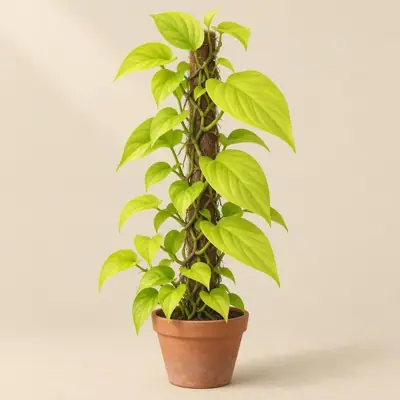
Overview
It is a perennial evergreen climbing or trailing vine that can use aerial roots to attach to supports, tree trunks, or other surfaces and can also be grown as a hanging plant.
Origin and habitat
Sources differ on its native range, with the Society Islands of French Polynesia, especially Mo'orea, given in the accounts. It is a climber of humid tropical forests, using aerial roots to attach to tree trunks, rocks, and other surfaces, and after introduction it has also become widely naturalized in tropical and subtropical forests. It prefers warm, humid tropical to subtropical conditions, tolerates heat, and has poor cold tolerance.
Characteristics
Sources differ, but mature height is reported at about 400–800 cm; sources are few for mature spread, which is reported at about 100–150 cm. Leaves are alternate; juvenile leaves are usually glossy, entire, and ovate to heart-shaped, while leaves on mature climbing plants become markedly larger and may develop irregular pinnate divisions, with green foliage commonly patterned in yellow or creamy white. The inflorescence consists of the typical aroid spadix and spathe; flowering is very rare in cultivation, though application of gibberellin can induce flowering.
Light
Sources differ in their descriptions of preferred light, ranging from bright indirect light and partial sun to partial shade; it tolerates low light, though insufficient light may reduce variegation and prolonged strong direct sunlight may scorch the leaves.
Watering
Use a well-drained medium and avoid prolonged waterlogging; during the growing season, watering can follow the beginning of surface drying, with drier management in winter, while excessive watering may cause root problems.
Humidity and airflow
It is generally reported to prefer high humidity.
Temperature and dormancy
Sources differ on the lower temperature limit, which is reported at about 5 °C. With few sources, the ideal temperature is reported at about 17–30 °C. A single source reports a USDA hardiness-zone range and that it tolerates brief light frost.
Growing medium and mounting
Use a fertile, well-drained medium; it can adapt to various soil types and to acidic, neutral, or alkaline conditions. It is generally reported to have aerial and soil roots and does well with an airy mix.
Feeding
Fertilizer can be applied during the growing season, and sources describe differing schedules using slow-release, liquid, or long-lasting fertilizers.
Propagation
Propagation is mainly by stem cuttings using stem sections with nodes; nodes can form roots, including when rooted in water.
Common problems
Possible pests include scale insects, spider mites, and greenhouse thrips. Anthracnose is reported as a possible disease, with particular attention warranted under hot, humid conditions. Excess watering may lead to root rot accompanied by yellowing and wilting, while cold or dry conditions may also cause yellowing and wilting; strong direct sunlight may scorch leaves, whereas insufficient light may reduce variegation or stall growth. It has poor cold tolerance and should be protected from frost and low temperatures; prolonged strong direct sunlight in summer may also scorch the leaves.
Identification
Sources differ in their descriptions, but identifying features include a climbing habit and aerial roots; leaves may gradually enlarge as the plant climbs, mature leaves may develop divisions, and hanging stems usually retain smaller juvenile-form leaves.
Photos


Sources
- Wikipedia (en): Epipremnum aureum — CC BY-SA 4.0 · link
- 維基百科:绿萝 — CC BY-SA 4.0 · link
- Wikipedia (ja): ポトス — CC BY-SA 4.0 · link
- Wikipedia (de): Efeutute — CC BY-SA 4.0 · link
- Wikipedia (fr): Epipremnum aureum — CC BY-SA 4.0 · link
- Wikipedia (es): Epipremnum aureum — CC BY-SA 4.0 · link
- NC State Plant Toolbox: Epipremnum aureum — copyright (facts only) · link
- Wikipedia (it): Epipremnum aureum — CC BY-SA 4.0 · link
- Wikipedia (pt): Epipremnum aureum — CC BY-SA 4.0 · link
- Wikipedia (ko): 스킨답서스 — CC BY-SA 4.0 · link
- TaiCOL 臺灣物種名錄: Epipremnum aureum — CC BY 4.0 · link
- RHS Plants: Epipremnum aureum — © RHS, facts only · link
- USDA PLANTS Database: Epipremnum aureum — Public domain (US Government work) · link
- 臺北典藏植物園 植物資料庫: Epipremnum aureum — © 臺北典藏植物園, facts only · link