
Epidendrum hybrid (Epidendrum hybrid)
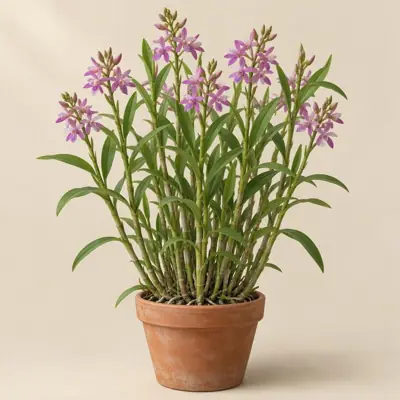
Epidendrum hybridum is reported to have a variable growth habit that may be epiphytic, terrestrial, or lithophytic, with stems that may be erect, pendent, or creeping, often reed-like, and sometimes branched or swollen.
Overview
Epidendrum hybridum is reported to have a variable growth habit that may be epiphytic, terrestrial, or lithophytic, with stems that may be erect, pendent, or creeping, often reed-like, and sometimes branched or swollen.
Origin and habitat
The genus Epidendrum is reported to be native to tropical and subtropical regions of the Americas, with a range extending from North Carolina to Argentina. Members of the genus are reported to occur as epiphytes, terrestrial plants, or lithophytes in habitats including humid jungle, dry tropical forest, sunny grassy slopes, cool cloud forest, and sandy barrier islands; many species occur at high elevations in the Andes. The genus spans tropical, subtropical, and cool high-elevation environments, and climatic adaptation is reported to vary greatly among species.
Characteristics
The source does not provide a specific leaf form, but reports that the plant's overall appearance and growth habit generally resemble Dendrobium. Flowers are reported to vary greatly in size and appearance and are mostly small to medium, with inflorescences that may be racemose, sometimes corymbose or paniculate, and often relatively dense; many species are fragrant, and an inflorescence may flower only once or continue flowering over successive years. Some Epidendrum suited to cool growing conditions are reported to flower throughout the year in subtropical areas such as Auckland, New Zealand. The fruit is reported to be an elliptical, ridged capsule.
Light
Epidendrum hybridum is reported to favor high light.
Watering
The source gives no fixed watering frequency and reports that the growing medium should remain well aerated, while some high-elevation cloud-forest species are highly sensitive to their native microenvironment. Epidendrum hybridum is generally kept slightly dry.
Temperature and dormancy
Epidendrum hybridum is generally associated with cool to intermediate conditions.
Growing medium and mounting
A humus-rich medium mixed with some sandy material may be used, and a humus-rich, well-aerated growing substrate is reported to be preferred; besides pot culture, some species may be grown in bark gardens or attached to trees. Bark is generally a preferred growing medium.
Common problems
Some high-elevation cloud-forest species are reported to be difficult to maintain after removal from their native habitat and may even die after being moved on the same host tree; the source suggests that dependence on symbiosis with particular mycorrhizal fungi may be involved. Cold tolerance is reported to vary markedly within the genus; some species prefer cool conditions, while E. conopseum, listed by the source with the synonym E. magnoliae, may tolerate prolonged freezing conditions.
Identification
Typical genus-level features are reported to include a slit in the rostellum that can produce a clear or white viscous liquid, a lip usually adnate to the column and forming a nectar tube, and pollen masses occurring in differing counts.