
Bolivian Torch Cactus (Echinopsis lageniformis)
Echinopsis lageniformis is an evergreen, spiny, columnar succulent cactus with a shrubby to small tree-like habit and some branching. It is reported to be a perennial evergreen succulent.
Overview
Echinopsis lageniformis is an evergreen, spiny, columnar succulent cactus with a shrubby to small tree-like habit and some branching. It is reported to be a perennial evergreen succulent.
Origin and habitat
It is native to Bolivia, with reliable sources agreeing on La Paz and Cochabamba and several also listing Chuquisaca and Tarija; sources differ on native occurrence in Santa Cruz and neighboring Peru. Sources differ on habitat accounts, which include cliffs near rivers, rocky slopes, and field margins. It grows mainly in dry, sunny desert or dry scrub environments.
Characteristics
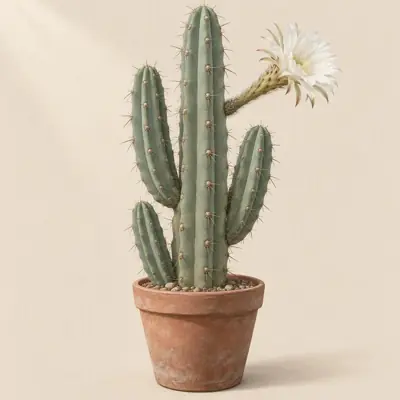
Mature plants reach 200–500 cm in height. It is reported to grow rapidly. Sources differ in their descriptions of the large, white, long funnel-shaped flowers, which open at night; some sources also describe them as fragrant. The fruit is reported as globose and hairy, though sources differ in their descriptions.
Light
It takes full sun and is generally reported to prefer full sun, with some afternoon shade in very hot climates.
Watering
It requires good drainage and avoidance of prolonged wet conditions, and should be kept drier during dormancy.
Temperature and dormancy
Few sources report a cold minimum of about 0 °C. It is generally reported to be frost tender; keep above freezing, and it is not frost tolerant. It is generally reported to rest cool and dry in winter.
Growing medium and mounting
A well-drained sandy or rocky medium is suitable; sources also recommend well-drained, near-neutral soil for cacti. It is generally reported to need a fast-draining mix.
Propagation
It can be propagated from seed, while stem cuttings can also be used for the genus Echinopsis.
Common problems
It is reported to be intolerant of frost, and prolonged wet conditions are generally unsuitable for cactus cultivation and unfavorable to its growth.
Identification
Sources differ in their descriptions, but the stems are cylindrical, pale green to blue-green and slightly glaucous, with blunt ribs; the areoles usually bear spines of varying lengths that range from yellow or honey-colored to brown, and mature plants are tall, columnar, and can branch.
Photos


Sources
- Wikipedia (en): Echinopsis lageniformis — CC BY-SA 4.0 · link
- Wikipedia (de): Echinopsis lageniformis — CC BY-SA 4.0 · link
- Wikipedia (es): Echinopsis lageniformis — CC BY-SA 4.0 · link
- LLIFLE Encyclopedia of living forms: Echinopsis lageniformis — CC BY-SA · link
- Useful Tropical/Temperate Plants: Echinopsis lageniformis — CC BY-NC-SA 3.0 (facts only) · link
- Desert-Tropicals: Echinopsis lageniformis — © Philippe Faucon (desert-tropicals.com), facts only · link
- NC State Plant Toolbox: Echinopsis (genus-level) — copyright (facts only) · link
- PUKUBOOK: Echinopsis lageniformis — CC BY-NC (facts only) · link