
peanut cactus (Echinopsis chamaecereus)
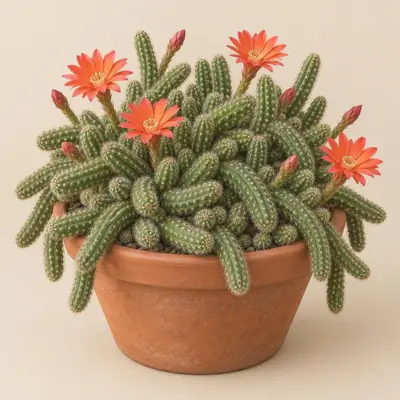
Echinopsis chamaecereus is a clustering cactus with many slender, finger-like stems that creep or trail and often form mats.
Overview
Echinopsis chamaecereus is a clustering cactus with many slender, finger-like stems that creep or trail and often form mats.
Origin and habitat
Sources differ on its native range, associating it with northwestern Argentina, particularly the Tucumán and Salta areas. Sources also differ on its wild habitat: some describe desert or dry scrub in northwestern Argentina, while others report that its actual vegetation habitat remains uncertain because it was not subsequently relocated in the wild.
Characteristics
Sources differ on mature height, which is reported at about 10–15 cm. Mature spread is 10–50 cm. The funnel-shaped flowers are described by sources as orange-red, scarlet, or red to orange; the supplied sources do not directly describe the flower color of the cultivar 'Westfield Alba'. Flowering occurs from late spring through summer; the fruit is generally reported to be dark red and spherical, containing small black seeds.
Light
Echinopsis chamaecereus takes full sun.
Watering
Water moderately during the growing period; during winter dormancy, give little or no water and avoid prolonged wetness. The winter watering interval is 30–90 days.
Temperature and dormancy
It rests cool and dry in winter. Sources differ on the minimum temperature, with about -7 °C reported; evidence for this value is limited.
Growing medium and mounting
Use a well-drained medium, such as loam or a sandy medium; a loam-based medium with added coarse grit is also recommended, and the medium may be acidic, neutral, or alkaline.
Feeding
A balanced liquid fertilizer is generally reported to be suitable during the growing season.
Propagation
It can be propagated from seed, offsets, or stem segments, and detached offsets readily root after contacting soil.
Common problems
Possible pests include mealybugs, scale insects, and mites. It is generally reported to have no significant disease problems. Cold or excessively wet winter conditions can encourage rot, and stem segments detach readily, so care is needed during repotting. It has some drought tolerance, while cold tolerance depends strongly on dry conditions and winter wetness increases the risk of rot.
Identification
The slender stems are finger-like or peanut-shaped, with ribs and many short, pale to white spines; they readily form dense clusters and gradually creep.
Photos


Sources
- Wikipedia (en): Echinopsis chamaecereus — CC BY-SA 4.0 · link
- Wikipedia (fr): Echinopsis chamaecereus — CC BY-SA 4.0 · link
- Wikipedia (es): Echinopsis chamaecereus — CC BY-SA 4.0 · link
- LLIFLE Encyclopedia of living forms: Echinopsis chamaecereus — CC BY-SA · link
- RHS Plants: Echinopsis chamaecereus — © RHS, facts only · link