
Echinodorus grisebachii (Echinodorus grisebachii)
Echinodorus grisebachii is reported to be a medium to large aquatic to marsh-growing herb with a rhizome and leaves arranged in a rosette. It is reported to be a perennial herb.
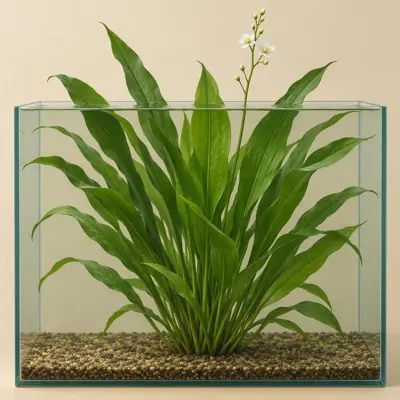
Overview
Echinodorus grisebachii is reported to be a medium to large aquatic to marsh-growing herb with a rhizome and leaves arranged in a rosette. It is reported to be a perennial herb.
Origin and habitat
Sources differ on its native range, describing it as Neotropical and including Cuba, with a distribution from Central America to South America; specifically cited areas include Honduras, Nicaragua, Costa Rica, Colombia, Venezuela, Ecuador, Peru, Bolivia, Suriname, French Guiana, and Brazil. It is reported from aquatic to marsh environments and can also be cultivated in ponds and artificial bodies of water. It occurs in the Neotropics; Colombian records include Orinoquia, the Pacific region, and the Magdalena River valley.
Characteristics
Few sources report a mature height of about 40–60 cm. Sources differ in their description of the leaves: they are arranged in a rosette and consist of a petiole and a single blade; submerged leaves can be long, with blades ranging from strap-shaped to linear, lanceolate, or narrowly ovate and colored medium to dark green, while the petiole may be flattened and triangular. It is reported to produce an inflorescence with flowers in groups of three.
Light
It is reported to require relatively strong lighting.
Watering
It is reported to be suitable for cultivation in aquariums, ponds, and artificial bodies of water, with no special water-quality requirements.
Identification
It is reported to be a robust, medium to large perennial aquatic or marsh-growing herb with a rhizome and long leaves arranged in a rosette; its submerged leaves can become long.
Photos

