
Mexican fire cracker (Echeveria shaviana)
This perennial is an evergreen, clumping rosette-forming leaf succulent that usually lacks an obvious stem and can produce offsets from the base.
Overview
This perennial is an evergreen, clumping rosette-forming leaf succulent that usually lacks an obvious stem and can produce offsets from the base.
Origin and habitat
It is native to mountainous areas of northeastern and northern Mexico, with Tamaulipas and Nuevo León specifically recorded. It is reported to grow in northern Mexican mountains in more shaded sites on boulders covered with pine needles. It is adapted to full sun or light shade, fast drainage and periods of drought, and can tolerate light frost.
Characteristics
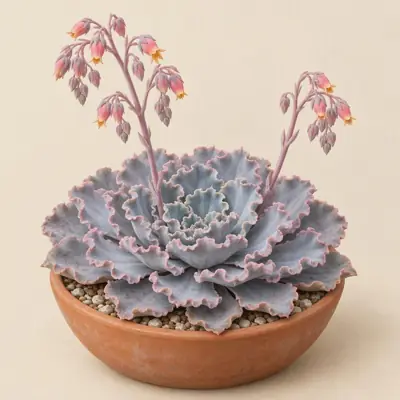
Sources are few, but mature height and spread are each reported at about 10–50 cm. The leaves form dense rosettes and are thin, smooth, obovate to obovate-spoon-shaped, gray-green to silvery gray with a powdery appearance, and have finely crinkled to strongly wavy margins; stronger light can bring out pink to red coloration. Sources differ in their descriptions of the flowers; they describe pink flowers with yellow inside, borne in summer on branched flower stalks, with the flowers tending toward one side of the inflorescence and often nodding, while RHS describes the flower shape as bell-shaped. Flowering occurs in summer, and the plant is reported to store water in its leaves.
Light
It grows in bright conditions through full sun and takes full sun, while also accepting light shade; some shade is advisable in hot areas. When moving it from weaker light into strong direct sun, acclimate it gradually to reduce the risk of sunburn.
Watering
During growth, water moderately while allowing the growing medium to drain rapidly and avoiding prolonged waterlogging; the plant is drought tolerant, and watering should be greatly reduced in winter so that conditions remain nearly dry.
Humidity and airflow
It is generally reported to prefer low humidity and needs good airflow.
Temperature and dormancy
Sources are few, but a minimum of about -1 °C is reported; it is also generally reported to tolerate brief light frost. A cold minimum of 5 °C is given, and the plant rests in winter. It is reported for a warm hardiness range, though this comes from a single source. In high summer temperatures it should be kept out of strong direct sun, and 'Pink Frills' is recorded as sensitive to summer heat.
Growing medium and mounting
Sources differ in their descriptions of the growing medium, but describe very loose, porous, fast-draining conditions; RHS recommends cactus compost and also lists loam or sandy soil, with acidic, neutral or alkaline conditions all suitable. It is reported to be prone to rot and to need a very fast-draining mix.
Feeding
Sources differ on feeding: one approach uses a slow-release fertilizer with low to moderate nitrogen during spring and summer growth, while RHS recommends a balanced liquid fertilizer applied monthly during the growing period.
Propagation
It can be propagated by seed, offsets and leaf cuttings. Leaf cuttings are possible but do not root especially easily in this species, and some leaves may dry out before forming a new plant.
Common problems
Potential pests include mealybugs, aphids and weevils. RHS generally reports few disease problems. Waterlogging readily causes root rot; cultivated plants may lose their roots, and leaf cuttings may dry out before forming new plants. It is reported to tolerate light frost and to be better suited to cool overwintering; in hot areas it needs some shade from strong sun, and a sudden move from weak light to full sun can cause sunburn.
Identification
Distinctive features include thin, delicate rosette leaves with strongly crinkled, wavy margins; the gray-green or silvery-gray leaves can develop pink to red margins under strong light.
Photos


Sources
- Wikipedia (en): Echeveria shaviana — CC BY-SA 4.0 · link
- LLIFLE Encyclopedia of living forms: Echeveria shaviana — CC BY-SA · link
- RHS Plants: Echeveria shaviana — © RHS, facts only · link
- Desert-Tropicals: Echeveria shaviana — © Philippe Faucon (desert-tropicals.com), facts only · link
- NHK みんなの趣味の園芸 植物図鑑: Echeveria shaviana — © NHK出版, facts only · link
- PUKUBOOK: Echeveria shaviana — CC BY-NC (facts only) · link
- Echeveria shaviana | Giromagi cactus and succulents for sale | Buy plants online (www.giromagi.com) — facts only (§12) · link