
Runyon's Echeveria (Echeveria runyonii)
Echeveria runyonii is a perennial evergreen succulent that forms rosettes and may grow singly or gradually form clumps.
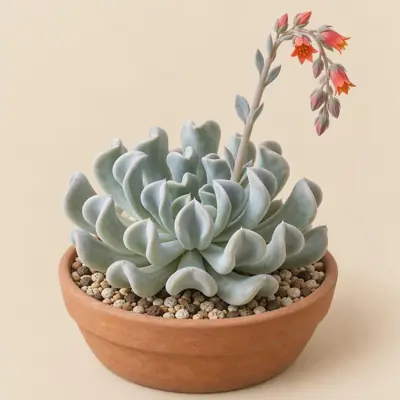
Overview
Echeveria runyonii is a perennial evergreen succulent that forms rosettes and may grow singly or gradually form clumps.
Origin and habitat
Sources differ on the origin account: the species Echeveria runyonii is native to Mexico, with more specific information pointing to Tamaulipas, while 'Topsy Turvy' is a mutant horticultural selection originating in California, United States.
Characteristics
Based on few sources, mature height is reported to be about 10–50 cm; sources differ on mature spread, placing it at about 10–12 cm. It is reported to form clumps slowly, with spoon-shaped succulent leaves arranged in rosettes; 'Topsy Turvy' is distinguished by recurved or seemingly upside-down leaves, with a conspicuous white powdery coating and leaf margins that can become pale pink in ample light. The species has red to red-orange flowers, while flowering time reported for different Echeveria species varies. It is reported to store water in its leaves.
Light
Sources differ somewhat on light: it suits bright light to full sun, with ample sun in spring and autumn, while excessive exposure should be avoided during hot summers and a partly shaded, well-ventilated position may be used. It takes full sun.
Watering
Sources differ on watering guidance: use a well-drained medium and avoid prolonged wetness; watering can be normal to moderate during growth and reduced during cold dormancy, when conditions should be kept on the dry side.
Humidity and airflow
It is generally reported to prefer low humidity and need good airflow.
Temperature and dormancy
It is frost tender; keep above freezing. Dormancy generally varies, and a single source reports a cold minimum of about -1 °C. It is less tolerant of hot, humid conditions, and excessive exposure should be avoided during hot summers.
Growing medium and mounting
Use a well-drained, well-aerated succulent or cactus medium; sandy medium can be used, and information for Echeveria also recommends a slightly acidic, well-drained sandy mix. It is prone to rot and needs a fast-draining mix.
Feeding
Small amounts of fertilizer may be applied during growth; sources describe balanced liquid fertilizer during growth or small amounts of slow-release or liquid fertilizer in spring and autumn.
Propagation
Propagation methods include division, stem cuttings, leaf cuttings, seed, tip cuttings, and separating basal offsets; the species can also be propagated from seed.
Common problems
Possible pests include scale insects, mealybugs, aphids, and weevils; information for Echeveria additionally lists mites, thrips, and root mealybugs. Echeveria runyonii is generally listed as having few disease problems, although humid conditions increase the risk of fungal problems and rot in Echeveria. Overly wet medium can cause rot, insufficient light can cause elongated growth, and touching or rubbing the powdery leaf coating can leave marks that affect appearance. It does not tolerate cold, cold and wet conditions, or hot and humid conditions; excessive exposure should be avoided in hot summers, while in cold conditions it should be moved to a bright indoor or frost-free location.
Identification
Its most distinctive features are recurved, seemingly inverted leaves and spoon-shaped rosettes covered with a thick white powdery coating.
Photos


Sources
- Wikipedia (en): Echeveria runyonii — CC BY-SA 4.0 · link
- Wikipedia (es): Echeveria runyonii — CC BY-SA 4.0 · link
- RHS Plants: Echeveria runyonii — © RHS, facts only · link
- Desert-Tropicals: Echeveria runyonii — © Philippe Faucon (desert-tropicals.com), facts only · link
- The Succulent Plant Page: Echeveria (genus-level) — © R.J. Hodgkiss, facts only · link
- 臺北典藏植物園 植物資料庫: Echeveria runyonii — © 臺北典藏植物園, facts only · link
- NHK みんなの趣味の園芸 植物図鑑: Echeveria (genus-level) — © NHK出版, facts only · link
- NC State Plant Toolbox: Echeveria (genus-level) — copyright (facts only) · link
- PUKUBOOK: Echeveria runyonii — CC BY-NC (facts only) · link