
Mexican hens-and-chicks (Echeveria lilacina)
Echeveria lilacina is an evergreen perennial succulent with leaves arranged in rosettes; it can form clumps but often remains solitary, with older plants only occasionally producing offsets. It is reported to be perennial.
Overview
Echeveria lilacina is an evergreen perennial succulent with leaves arranged in rosettes; it can form clumps but often remains solitary, with older plants only occasionally producing offsets. It is reported to be perennial.
Origin and habitat
Echeveria lilacina is native to Mexico, with more specific sources placing its native range in Nuevo León in northern Mexico. It occurs on rocky ground or rocky outcrops at high elevations. It is adapted to dry conditions and is drought tolerant, with its native habitat in higher-elevation rocky environments.
Characteristics
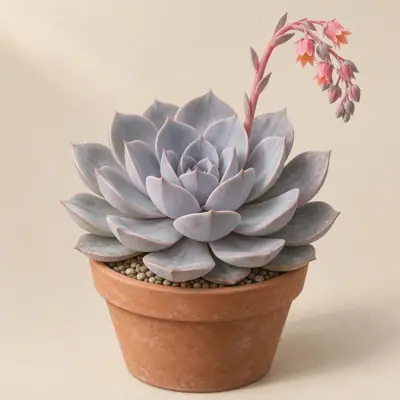
Sources differ on mature size, giving a height of about 10–15 cm and, from few sources, a spread of about 10–50 cm. Growth is slow, and the thick, succulent, spoon-shaped, upward-curving leaves form symmetrical rosettes; they are silver-gray to nearly white with blue tones and a powdery waxy coating, and can develop pale lilac or purple coloration in strong light. The pale pink, pale orange to coral-red flowers are borne on reddish, relatively short, curved flower stalks or racemes, and flowering occurs from late winter to early spring. It stores water in its leaves.
Light
Full sun is preferred, though partial shade is also tolerated; stronger light helps maintain a compact form and pronounced leaf coloration, while a sudden move from weaker light into full sun should be avoided to prevent sunburn. It takes full sun.
Watering
Sources differ on watering: provide moderate water during growth without allowing the growing medium to remain waterlogged between waterings; the plant tolerates extended dry periods, and watering can be stopped during winter dormancy.
Humidity and airflow
It is reported to prefer low humidity and need good airflow.
Temperature and dormancy
Sources differ on the minimum temperature, placing it at about 0 °C, while another supported claim gives a cold minimum of 5 °C. It is reported to tolerate brief light frost and rests in winter. It is reported to be less suited to hot, humid conditions; in summer, strong direct light should be avoided because intense light can cause leaf scorch.
Growing medium and mounting
Use a rapidly draining, very loose and permeable succulent or cactus growing medium; suitable soil types include loam and sandy soil, and the medium may be acidic, neutral, or alkaline. It is reported to be prone to rot and needs a very fast-draining mix.
Feeding
A slow-release fertilizer with low to moderate nitrogen is reported to be suitable during spring and summer growth, after which additional feeding can generally wait until the following spring.
Propagation
Sources differ on propagation details, describing division of offsets or larger clumps, seed, and root, stem, or leaf cuttings; cut propagation material can be allowed to dry at the wound before planting. Supported propagation methods include division, offsets, seed, and root, stem, and leaf cuttings.
Common problems
Possible pests include aphids, mealybugs, and weevils. It is generally described as having few disease problems, but prolonged waterlogging can lead to root rot. Prolonged waterlogging may cause root rot, a sudden move from low light to full sun may cause sunburn, and excessive moisture during cold weather is also unfavorable. Sources differ on frost sensitivity: some report tolerance of brief light frost, while other guidance recommends avoiding frost during overwintering.
Identification
Echeveria lilacina has neat, nearly flat rosettes with silver-gray to nearly white leaves covered by a powdery waxy coating and showing blue-purple tones; strong light can bring out a pale lilac flush.
Photos


Sources
- Wikipedia (en): Echeveria lilacina — CC BY-SA 4.0 · link
- LLIFLE Encyclopedia of living forms: Echeveria lilacina — CC BY-SA · link
- RHS Plants: Echeveria lilacina — © RHS, facts only · link
- The Succulent Plant Page: Echeveria (genus-level) — © R.J. Hodgkiss, facts only · link
- NHK みんなの趣味の園芸 植物図鑑: Echeveria (genus-level) — © NHK出版, facts only · link
- NC State Plant Toolbox: Echeveria (genus-level) — copyright (facts only) · link
- PUKUBOOK: Echeveria lilacina — CC BY-NC (facts only) · link
- Echeveria lilacina | Giromagi cactus and succulents for sale | Buy plants online (www.giromagi.com) — facts only (§12) · link