
Mexican snowball (Echeveria elegans)
Echeveria elegans is an evergreen perennial succulent with no conspicuous stem, forming tight rosettes and dense mat-like clumps through runners and offsets.
Overview
Echeveria elegans is an evergreen perennial succulent with no conspicuous stem, forming tight rosettes and dense mat-like clumps through runners and offsets.
Origin and habitat
Sources differ on the details of its native range: it is native to Mexico, with more specific accounts placing it in central Mexico in Hidalgo and mountainous areas near Pachuca. Its habitat includes semi-arid to semi-desert mountain environments in Mexico, where it can grow in rock crevices and on rocky outcrops. It is suited to subtropical conditions, its native habitat is relatively semi-arid, and in cultivation it can adapt to a subtropical climate similar to that of Southern California.
Characteristics
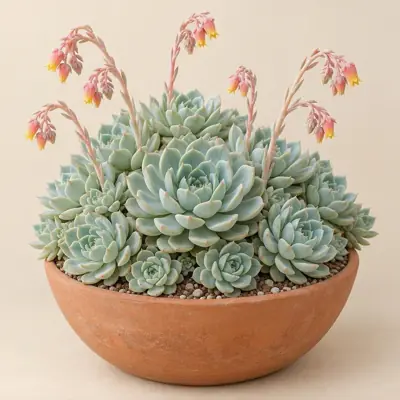
Mature plants are 5–10 cm tall; sources differ on spread, placing it at about 50 cm. The fleshy leaves store water and form dense rosettes; they range from pale blue-green and gray-blue to powdery whitish green, may be obovate or spoon-shaped, have a powdery surface, and can show reddish margins or tips and sometimes translucent-looking margins. Slender flower stalks bear one-sided inflorescences with pink, coral-pink, or reddish-pink flowers with yellow tips, described by some sources as bell- or lantern-shaped; sources differ on flowering season, describing flowering mainly from late winter into spring, sometimes continuing into summer or midsummer under cultivation. The plant can gradually expand into colonies through abundant side shoots and runners.
Light
It can grow in full sun to part shade, with RHS recommending full sun, and it tolerates bright light or part shade.
Watering
It has moderate water needs but should not be overwatered; the growing medium should drain well, with moderate watering during active growth and reduced or stopped watering during dormancy. A single source reports a winter watering interval of about 21–30 days, so sources are few.
Humidity and airflow
Based on limited single-source information, it generally prefers low humidity and needs good airflow.
Temperature and dormancy
Limited single-source information places the cold minimum at about 7 °C; sources are few. Hardiness classifications are given under both USDA and RHS systems, while a single source reports that it is frost tender and should be kept above freezing. Dormancy is reported to vary. A single source reports that the plant is weaker under hot, humid conditions and is better placed in a ventilated, partly shaded environment in summer.
Growing medium and mounting
It needs a fast-draining, porous growing mix; loamy or sandy media can be used, and container mixes can include coarse material to improve drainage. It can adapt to acidic, neutral, or alkaline pH.
Feeding
A single source reports that a balanced liquid fertilizer can be applied during the growing season.
Propagation
Echeveria elegans can be propagated by separating offsets, stem cuttings, leaf cuttings, or seed. Offsets produced by the parent plant can be separated in spring and grown separately.
Common problems
Potential pests include mealybugs, aphids, and weevils, while significant diseases are generally uncommon. Overwatering is a common cultivation problem, and insufficient light can cause elongated, weaker growth with paler coloration. It does not tolerate frost or low temperatures, and in temperate regions it is suited to cultivation in protected or heated conditions.
Identification
Echeveria elegans forms neat, tight, pale blue-green to powdery whitish rosettes close to the ground, later developing dense mat-like clumps through offsets or runners and producing slender pink flower stalks with pink flowers tipped in yellow.
Photos


Sources
- Wikipedia (en): Echeveria elegans — CC BY-SA 4.0 · link
- 維基百科:月影 — CC BY-SA 4.0 · link
- Wikipedia (fr): Echeveria elegans — CC BY-SA 4.0 · link
- Wikipedia (es): Echeveria elegans — CC BY-SA 4.0 · link
- NC State Plant Toolbox: Echeveria elegans — copyright (facts only) · link
- Wikipedia (it): Echeveria elegans — CC BY-SA 4.0 · link
- Wikipedia (nl): Echeveria elegans — CC BY-SA 4.0 · link
- Wikipedia (pt): Echeveria elegans — CC BY-SA 4.0 · link
- TaiCOL 臺灣物種名錄: Echeveria elegans — CC BY 4.0 · link
- LLIFLE Encyclopedia of living forms: Echeveria elegans — CC BY-SA · link
- RHS Plants: Echeveria elegans — © RHS, facts only · link
- Desert-Tropicals: Echeveria elegans — © Philippe Faucon (desert-tropicals.com), facts only · link
- NHK みんなの趣味の園芸 植物図鑑: Echeveria (genus-level) — © NHK出版, facts only · link
- The Succulent Plant Page: Echeveria (genus-level) — © R.J. Hodgkiss, facts only · link