
Lipstick (Echeveria agavoides)
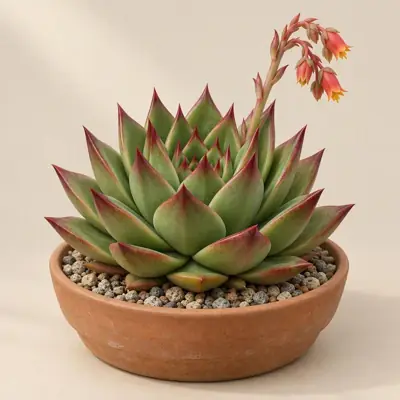
Echeveria agavoides is a perennial evergreen succulent that forms tight rosettes, usually remaining solitary, although older or vigorous plants may slowly produce offsets and form clumps.
Overview
Echeveria agavoides is a perennial evergreen succulent that forms tight rosettes, usually remaining solitary, although older or vigorous plants may slowly produce offsets and form clumps.
Origin and habitat
Echeveria agavoides is native to Mexico, especially central Mexico; specifically listed areas include San Luis Potosí, Hidalgo, Guanajuato, and Durango, while broader records also include Aguascalientes, Jalisco, Querétaro, and Zacatecas, with observations extending from Coahuila to Oaxaca. Its habitat includes rocky canyons, dry slopes, and rocky outcrops at higher elevations. It occurs in dry, rocky environments of central Mexico and is also described as a subtropical succulent.
Characteristics
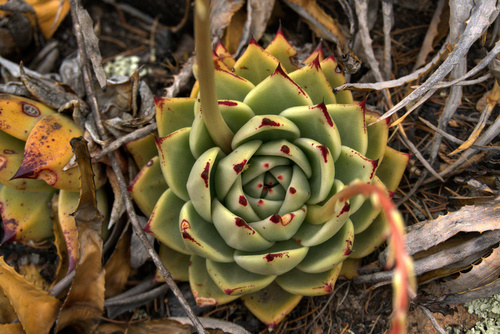
Sources differ on mature size, giving a height of about 5–12 cm and a spread of about 7–35 cm. It grows relatively quickly among Echeveria, although offsets may develop very slowly or not at all, and it stores water in its leaves. The thick, ovate to triangular leaves have sharp tips and are usually green to pale apple green; strong light or some forms can produce red, copper-red, or deep-red tips and margins. The pink-red, orange-red, or red flowers are conical to urn- or lantern-shaped with dark-yellow or yellow petal tips, are arranged to one side of the inflorescence, and bloom in summer.
Light
Sources differ in their descriptions of light, but Echeveria agavoides is suited to bright conditions through full sun; ample light helps maintain compact growth, leaf color, and flowering, while a sudden move from weak light into intense summer sun can cause sunburn. It takes full sun.
Watering
Water moderately during growth without leaving the growing medium persistently waterlogged; the plant can tolerate periods of drought, while winter watering should be greatly reduced to nearly dry conditions and excess moisture should also be avoided during hot, humid periods. In winter, watering is specified at intervals of 21–60 days.
Humidity and airflow
It is reported to prefer low humidity and to need good airflow.
Temperature and dormancy
The limited sources indicate a minimum around 5 °C. Hardiness is described using both USDA and RHS classifications, and the plant is reported to be frost tender and should be kept above freezing. It is reported to rest in winter. It is less tolerant of hot, humid conditions, and intense afternoon sun should be avoided during hot summers.
Growing medium and mounting
Use a well-drained, porous growing medium; sources recommend mineral-based media, standard cactus potting mix, and loamy or sandy soil, and the roots should not remain in standing water. It is prone to rot and needs a fast-draining mix.
Feeding
During growth, a balanced liquid fertilizer may be applied regularly; small amounts of slow-release or liquid fertilizer may also be used during the spring and autumn growth periods of Echeveria.
Propagation
Sources differ on propagation details, but methods described include leaf cuttings, stem cuttings, division, separating offsets, and seeds. Cut leaves or stems may be allowed to dry and callus before planting.
Common problems
Potential pests include mealybugs, vine weevils, and aphids, while general Echeveria information also lists scale insects, spider mites, thrips, and root mealybugs. Disease is generally described as uncommon, but poor drainage or excess moisture can lead to root rot and other rotting. Waterlogging can cause root rot, insufficient light can cause elongated, loose growth and faded color, and a sudden move from weak light into intense summer sun can cause sunburn. It does not tolerate cold, wet winters or prolonged hot, humid conditions well, and intense afternoon sun in hot areas may cause stress, with shade provided according to conditions.
Identification
Echeveria agavoides is distinguished by an almost stemless, star-shaped tight rosette with especially thick, sharply pointed triangular leaves that resemble Agave; the leaf tips or margins often become reddish depending on form and light.
Photos


Sources
- Wikipedia (en): Echeveria agavoides — CC BY-SA 4.0 · link
- Wikipedia (de): Echeveria agavoides — CC BY-SA 4.0 · link
- Wikipedia (fr): Echeveria agavoides — CC BY-SA 4.0 · link
- LLIFLE Encyclopedia of living forms: Echeveria agavoides — CC BY-SA · link
- RHS Plants: Echeveria agavoides — © RHS, facts only · link
- Desert-Tropicals: Echeveria agavoides — © Philippe Faucon (desert-tropicals.com), facts only · link
- The Succulent Plant Page: Echeveria (genus-level) — © R.J. Hodgkiss, facts only · link
- NHK みんなの趣味の園芸 植物図鑑: Echeveria (genus-level) — © NHK出版, facts only · link
- Echeveria agavoides | Giromagi cactus and succulents for sale | Buy plants onlin (www.giromagi.com) — facts only (§12) · link
- PUKUBOOK: Echeveria agavoides — CC BY-NC (facts only) · link