
golden dewdrops (Duranta erecta)
Duranta erecta is an evergreen, spreading or somewhat drooping shrub, occasionally developing into a small tree; mature plants often bear axillary spines. It is reported to be perennial.
Overview
Duranta erecta is an evergreen, spreading or somewhat drooping shrub, occasionally developing into a small tree; mature plants often bear axillary spines. It is reported to be perennial.
Origin and habitat
Sources differ on its native range: it occurs in tropical and subtropical America, with a core range including Mexico, Central America, the Caribbean, and South America, extending south to Argentina and Uruguay, while the native status of some populations in the southern United States is disputed. It occurs in dry to moist disturbed environments, roadsides, scrub, secondary forest, and rocky or sandy coastal sites, with records also from forests and various seasonal woodlands. It is adapted to tropical to warm subtropical climates and does not tolerate frost; in colder regions it can be grown as an annual or overwintered in a container.
Characteristics
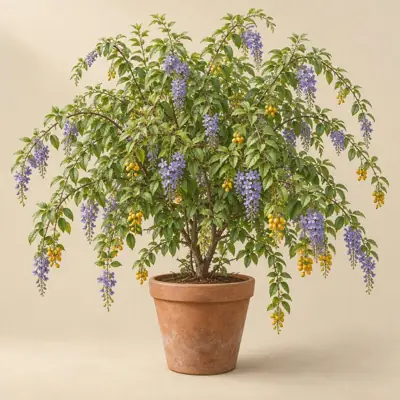
Sources differ on mature height, placing it at about 180–600 cm. A single source reports a mature spread of about 600–600 cm. It grows rapidly, with substantial annual growth possible before maturity; leaves are opposite, sometimes densely arranged or nearly whorled on some branches, and range from elliptic and ovate to obovate, with entire or serrated margins and typically light green to green coloration. The small flowers are commonly pale blue, lavender-purple, purple, or white and form terminal and axillary racemes that often droop, with other flower colors occurring in some horticultural forms; sources differ on flowering period, describing flowering mainly from late spring through autumn or in summer, potentially extending to nearly year-round in warm regions, while the fruit is a small, nearly spherical to ovoid drupe that matures from yellow to orange-yellow, is often borne in clusters, and contains multiple seeds.
Light
Duranta erecta grows in full sun.
Watering
It prefers moist, well-drained soil but also tolerates drought.
Growing medium and mounting
Moist, fertile, well-drained soil is preferred, although the plant also tolerates drier and less fertile conditions.
Propagation
It can be propagated by cuttings, air layering, or seed; sources describe taking cuttings in spring and report that they can root relatively quickly.
Common problems
It can escape cultivation and become naturalized, and is invasive in some tropical and subtropical regions; removing fruit after fruiting can reduce potential spread. It does not tolerate frost and may lose leaves in cold conditions; in colder regions it is often grown as an annual or moved indoors before frost.
Identification
Branches are often spreading or drooping, mature branches may develop axillary spines, and the plant bears clusters of blue-purple flowers and conspicuous yellow to orange-yellow fruit.
Photos


Sources
- Wikipedia (en): Duranta erecta — CC BY-SA 4.0 · link
- 維基百科:金露花 — CC BY-SA 4.0 · link
- Wikipedia (ja): デュランタ — CC BY-SA 4.0 · link
- Wikipedia (de): Duranta erecta — CC BY-SA 4.0 · link
- Wikipedia (fr): Vanillier de Cayenne — CC BY-SA 4.0 · link
- Wikipedia (es): Duranta erecta — CC BY-SA 4.0 · link
- GBIF descriptions: The checklist of alien seed plants of D.R. Congo, based on evidence from herbarium collections; Chec — per dataset · link
- NC State Plant Toolbox: Duranta erecta — copyright (facts only) · link
- TaiCOL 臺灣物種名錄: Duranta erecta — CC BY 4.0 · link
- 農業知識入口網 植物圖鑑: Duranta erecta — © MOA, facts only · link
- Useful Tropical/Temperate Plants: Duranta erecta — CC BY-NC-SA 3.0 (facts only) · link
- USDA PLANTS Database: Duranta erecta — Public domain (US Government work) · link