
Madagascar Sundew (Drosera madagascariensis)
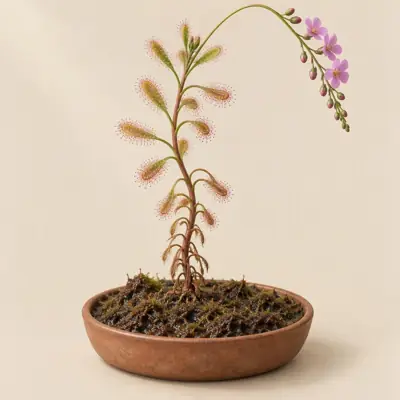
Drosera madagascariensis is a perennial, stem-forming, herbaceous carnivorous plant; young plants have upright stems, while mature stems may recline and extend or use their leaves to cling to surrounding vegetation. It is reported to be perennial.
Overview
Drosera madagascariensis is a perennial, stem-forming, herbaceous carnivorous plant; young plants have upright stems, while mature stems may recline and extend or use their leaves to cling to surrounding vegetation. It is reported to be perennial.
Origin and habitat
It is native to Africa, ranging from tropical Africa southward into southern Africa and including Madagascar; sources differ in their regional accounts, which include Guinea, Nigeria, Cameroon, the Congo region, Angola, the Zambezi or Zambia region, Tanganyika or Tanzania, South Africa and Madagascar, with a French source also listing Eswatini. It grows in persistently wet environments, including swamps, wetlands, riverbanks, lakeshores, Sphagnum bogs and places that remain wet throughout the year within seasonally dry wet grasslands. It occurs mainly in tropical regions; a French source describes it as primarily associated with tropical biomes having a dry season, while its actual microhabitats remain wet.
Characteristics
Mature height ranges from 0 to 25 cm. The leaves are arranged alternately to spirally, with older leaves bending backward or drying and remaining on the lower stem; the blades bear carnivorous tentacles and range from obovate and elliptic to spoon-shaped, while sources differ on leaf and petiole dimensions. Sources differ in their descriptions of flower and inflorescence dimensions and counts; the plant bears cymose inflorescences, with usually pink to purple, obovate-petaled flowers, and the sepals may bear glandular hairs or soft hairs. The fruit is a dehiscent capsule containing many spindle-shaped, brownish-black seeds, and sources differ on seed length.
Light
It is generally grown in full sun with good ventilation.
Watering
Ecological information from its natural habitats indicates persistently wet conditions, supporting cultivation that maintains moisture rather than allowing the growing medium to remain dry for extended periods. It is generally reported to require pure water only (rain, RO or distilled) and to be compatible with tray (bottom) watering. Keep wet.
Growing medium and mounting
Low-nutrient growing media are generally recommended; genus-level cultivation information suggests Sphagnum alone or a mixture of fine Kanuma, fine akadama and unadjusted peat in equal proportions, while another source recommends a mixture of low-nutrient peat and sand. Sand with peat is generally recommended.
Feeding
Fertilizer is generally not applied, and general cultivation information explicitly recommends avoiding it. It is reported to grow without supplementary feeding of insects.
Propagation
Genus-level cultivation information reports propagation by division, leaf cuttings and seed.
Common problems
Genus-level cultivation information reports aphids and spider mites, with aphids more likely under poor ventilation and spider mites more likely under hot, dry conditions. General Drosera horticultural information is reported not to identify notable disease problems. Dry conditions may be unsuitable for maintaining its wetland-type growing conditions, while genus-level information also associates poor ventilation with aphid problems and hot, dry air with spider mites.
Identification
Drosera madagascariensis has a conspicuous stem axis; young plants are upright, while in more mature plants only the stem tip can support itself, and the stem may recline or use leaves to cling to surrounding vegetation. Older leaves commonly bend backward, and the base of the inflorescence is conspicuously curved; a monograph cited by GBIF treats these reflexed leaves and the strongly curved inflorescence base as important identification features.
Photos


Sources
- GBIF Backbone: Drosera madagascariensis DC. — CC BY 4.0 · link
- Wikipedia (en): Drosera madagascariensis — CC BY-SA 4.0 · link
- 維基百科:馬達加斯加毛氈苔 — CC BY-SA 4.0 · link
- Wikipedia (de): Drosera madagascariensis — CC BY-SA 4.0 · link
- Wikipedia (fr): Drosera madagascariensis — CC BY-SA 4.0 · link
- Wikipedia (es): Drosera madagascariensis — CC BY-SA 4.0 · link
- GBIF descriptions: Synopsis of the genus Drosera (Droseraceae) in Angola and the Democratic Republic of the Congo — per dataset · link
- NHK みんなの趣味の園芸 植物図鑑: Drosera (genus-level) — © NHK出版, facts only · link
- NC State Plant Toolbox: Drosera (genus-level) — copyright (facts only) · link