
Cape sundew (Drosera capensis)
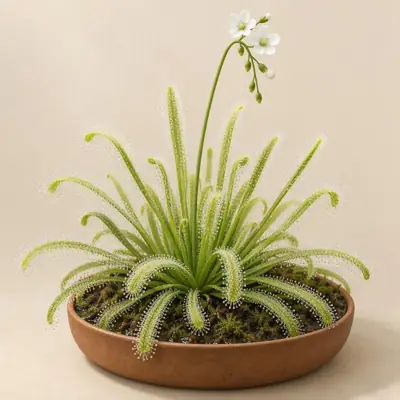
Drosera capensis is a perennial carnivorous herb that grows in rosette-like clumps, and some forms can develop a short stem as old leaves accumulate.
Overview
Drosera capensis is a perennial carnivorous herb that grows in rosette-like clumps, and some forms can develop a short stem as old leaves accumulate.
Origin and habitat
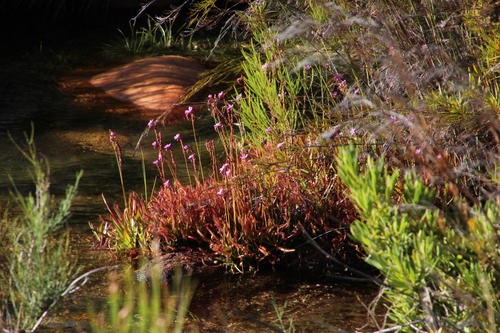
Drosera capensis is native to the Cape region of South Africa, mainly southwestern South Africa, while broader accounts place it in southern Africa. It is reported to occur in persistently wet, nutrient-poor habitats, including marshes and areas around lakes, favoring wet to waterlogged, nutrient-poor, lime-free substrates. Its native environment is reported to be mild and humid, with plants growing from full sun to partial sun.
Characteristics
Sources differ on mature size, placing both height and spread at about 10–50 cm. It is reported to grow and propagate easily, with some sources describing rapid growth; its narrow, linear to narrowly spoon-shaped, semi-upright leaves have distinct petioles and dense mucilage-secreting glandular hairs, and a leaf can bend around trapped prey. Sources differ in describing the flowers and flowering period: the 'Alba' form has white flowers, while the typical species usually has pink, magenta, or pale purple flowers, with multiple flowers borne above the leaves, and flowering occurs mainly during warm periods. The flowers are reported to self-pollinate and produce many small seeds that disperse from the dried flower parts after ripening.
Light
Drosera capensis favors full sun or bright conditions but can accept partial sun; in warm regions it can be grown in full sun in moist, acidic conditions, while greenhouse plants may be given some shade under intense hot sunlight.
Watering
Keep the substrate wet; tray (bottom) watering is suitable, and pots can draw water from a shallow tray of rainwater. Pure water only (rain, RO or distilled) is generally recommended, while other sources also recommend rainwater or low-mineral water.
Humidity and airflow
It generally prefers moderate humidity; one source reports an approximate humidity range of 40–80 %, so sources for this range are few.
Temperature and dormancy
A single source reports an approximate temperature range of 5–40 °C, with about 5 °C as the minimum and about 40 °C as the maximum, so sources for these figures are few. It is generally reported to tolerate brief light frost. Sources differ on dormancy, with one source describing no dormancy.
Growing medium and mounting
Use a nutrient-poor, wet to waterlogged, acidic substrate; sources also describe suitable soil reaction as acidic to neutral. Sand with peat is generally recommended.
Feeding
Fertilizer is generally avoided because the roots and substrate are adapted to nutrient-poor conditions and may be adversely affected by inappropriate fertilization. It is reported to grow without being fed insects.
Propagation
Drosera capensis can be propagated from seed, leaf cuttings, root cuttings, or division; it produces many seeds that generally germinate readily.
Common problems
Sources differ on pest problems, reporting that sundews may be affected by aphids when airflow is poor and by spider mites in hot, dry conditions. Serious diseases are generally reported to be uncommon. Dry or high-fertility management is unsuitable, and the substrate should not be allowed to lose its persistently moist condition. Severe frost should be avoided in cold regions; reports indicate limited cold tolerance while also noting tolerance of light frost, and another source reports that above-ground growth may wither in hot conditions.
Identification
Sources differ in describing the distinguishing features of 'Alba', whose main differences from the typical form are reported to be white flowers and glandular hairs lacking vivid red coloration; its sticky glandular hairs trap arthropods, after which the leaf gradually bends around and digests the prey.
Photos


Sources
- GBIF Backbone: Drosera capensis L. — CC BY 4.0 · link
- Wikipedia (en): Drosera capensis — CC BY-SA 4.0 · link
- 維基百科:好望角毛氈苔 — CC BY-SA 4.0 · link
- Wikipedia (ja): アフリカナガバノモウセンゴケ — CC BY-SA 4.0 · link
- Wikipedia (de): Kap-Sonnentau — CC BY-SA 4.0 · link
- Wikipedia (fr): Drosera capensis — CC BY-SA 4.0 · link
- Wikipedia (es): Drosera capensis — CC BY-SA 4.0 · link
- GBIF descriptions: DAISIE - Inventory of alien invasive species in Europe; Species plantarum: exhibentes plantas rite c — per dataset · link
- Wikipedia (it): Drosera capensis — CC BY-SA 4.0 · link
- Wikipedia (nl): Kaapse zonnedauw — CC BY-SA 4.0 · link
- RHS Plants: Drosera capensis — © RHS, facts only · link
- USDA PLANTS Database: Drosera capensis — Public domain (US Government work) · link
- NHK みんなの趣味の園芸 植物図鑑: Drosera capensis — © NHK出版, facts only · link
- NC State Plant Toolbox: Drosera (genus-level) — copyright (facts only) · link