
Drosera burmannii (Drosera burmannii)
Drosera burmannii is a small, compact carnivorous herb with leaves forming a rosette close to the ground. Sources differ on its life cycle: it is usually annual in the wild, while another account describes it as annual or biennial; in cultivation, it can survive for multiple years if moved indoors during cold months.
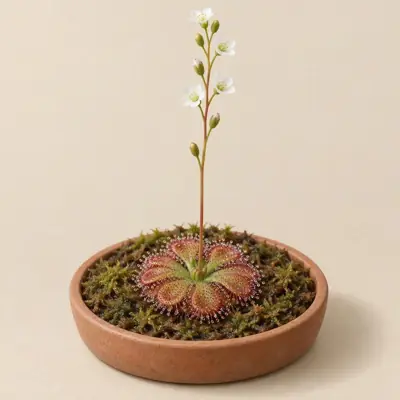
Overview
Drosera burmannii is a small, compact carnivorous herb with leaves forming a rosette close to the ground. Sources differ on its life cycle: it is usually annual in the wild, while another account describes it as annual or biennial; in cultivation, it can survive for multiple years if moved indoors during cold months.
Origin and habitat
Drosera burmannii is distributed across tropical and subtropical parts of Asia and Australia, including India, Taiwan, Southeast Asia, Guangxi, Guangdong, Yunnan, and Fujian; it is confirmed as native in Taiwan, and another source also records it as native in the PB region. Drosera species are reported from peat bogs, wetlands, and marsh environments. Its climate is reported to range from tropical to subtropical.
Characteristics
A limited source reports a mature spread of about 2 cm. The red or green leaves form a ground-level rosette, are wedge-shaped to nearly round, and bear mucus-secreting structures that trap prey. It is reported to produce white flowers in groups on racemes, with multiple inflorescences possible on a plant.
Light
It is generally recommended to provide ample sunlight and good ventilation, with full sun indicated.
Watering
The growing medium is generally kept continuously moist, and related Drosera cultivation information likewise recommends maintaining moisture throughout the year. Pure water only (rain, RO or distilled) and tray (bottom) watering are generally indicated; the plant is reported to be compatible with this method, with the moisture target being to keep wet.
Growing medium and mounting
A low-fertility medium is generally recommended, including sphagnum moss or a mixture of fine Kanuma, fine akadama, and unadjusted peat in equal proportions; poor peat and sandy media are also reported for Drosera.
Feeding
Fertilizer is generally not applied, and intentionally feeding insects is not considered necessary; the plant is reported to grow without insect feeding.
Propagation
Drosera can be propagated from seed, leaf cuttings, or division, and Drosera burmannii produces abundant seed in connection with its annual life cycle.
Common problems
Drosera cultivation information reports aphids and spider mites as pests, with aphids more likely under poor ventilation and spider mites more likely under hot, dry conditions. Drosera information generally does not identify major pest or disease problems. Poor ventilation is reported to potentially increase aphid problems, while hot, dry air may increase spider-mite damage.
Identification
Drosera burmannii traps and digests insects with leaf-surface mucus; after capturing prey, its leaves can bend inward, and its trapping response is particularly rapid, beginning to envelop an insect quickly.
Photos


Sources
- Wikipedia (en): Drosera burmanni — CC BY-SA 4.0 · link
- Wikipedia (en): Drosera burmannii — CC BY-SA 4.0 · link
- TaiCOL 臺灣物種名錄: Drosera burmannii — CC BY 4.0 · link
- USDA PLANTS Database: Drosera burmannii — Public domain (US Government work) · link
- NHK みんなの趣味の園芸 植物図鑑: Drosera (genus-level) — © NHK出版, facts only · link
- NC State Plant Toolbox: Drosera (genus-level) — copyright (facts only) · link