
Drosera adelae (Drosera adelae)
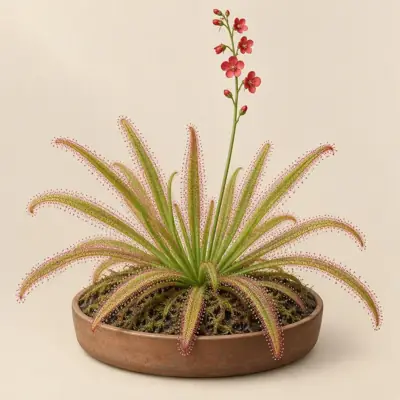
Drosera adelae is reported to be a terrestrial, carnivorous perennial herb with leaves forming a basal rosette.
Overview
Drosera adelae is reported to be a terrestrial, carnivorous perennial herb with leaves forming a basal rosette.
Origin and habitat
Sources differ in describing its native range, which is given as endemic to Queensland, Australia, with Rockingham Bay and the Hinchinbrook Island area specifically mentioned. It is reported from moist, shaded tropical rainforest habitats in Queensland, including sandy soil along streams, among moss-covered rocks, wet rocks near waterfalls, and high-rainfall mountain environments. Its climate is reported to be humid and tropical, with high humidity and substantial shade in its natural environment.
Characteristics
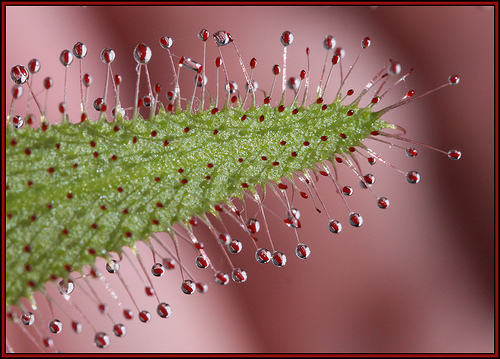
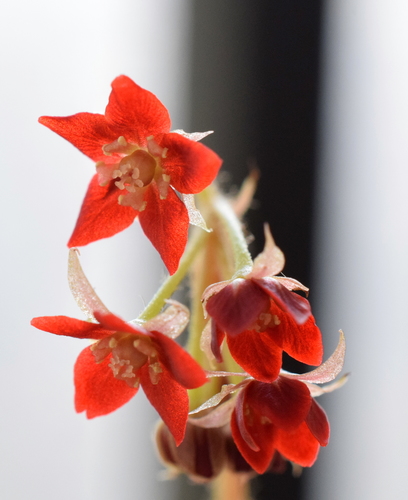
Few-source reporting places mature spread at about 0–30.48 cm and mature height at about 15–25 cm. It is reported to grow rapidly and produce new plants from roots or underground extensions, often forming colonies. Sources differ in describing the narrow lanceolate to linear, sword-shaped leaves and their appearance: the petiole is very short or inconspicuous, the upper surface bears sticky prey-catching glandular hairs, the underside is hairless, and leaves tend to be greener and longer in weaker light but shorter and bronze, red, or dark red in stronger light. Sources differ on aspects of the small flowers, which are borne in racemes and may be red to red-orange or, in some accounts, cream-colored; flowering is reported from the Australian winter into spring, with cultivation conditions potentially altering its timing.
Light
Bright, indirect light to shaded conditions are reported to be suitable, and although Drosera adelae can adapt to brighter light, direct strong sunlight may scorch unacclimated leaves. In weaker light, leaves are reported to become longer and greener, while stronger light tends to produce shorter leaves that more readily become red or bronze.
Watering
It is reported to favor moist conditions, consistent with wild habitats along streams and near waterfalls, while general Drosera cultivation information also recommends keeping the medium continuously wet and using tray (bottom) watering. Pure water only (rain, RO or distilled) is generally recommended.
Humidity and airflow
A limited source reports humidity at about 80–90 %.
Temperature and dormancy
A limited source reports an ideal temperature range of about 18–30 °C and a maximum of about 30 °C. Sources differ on the reported minimum temperature, which is about 5 °C. It is generally reported to tolerate brief light frost.
Growing medium and mounting
It is reported from sandy soil along streams in its native habitat, while general Drosera cultivation information recommends low-fertility media such as a peat-and-sand mixture or sphagnum moss. Sand with peat is generally reported as a substrate type.
Feeding
It is generally grown without fertilizer and is reported to grow without being fed insects.
Propagation
It is reported to naturally produce adventitious buds or new plants from its roots and form colonies, and it can also be propagated in cultivation by root cuttings, leaf cuttings, and seed.
Common problems
Sources differ on general Drosera cultivation accounts of aphids and spider mites, with aphids associated with poor airflow and spider mites with hot, dry conditions. Insufficient humidity is reported to contribute to cultivation failure, while sudden exposure to direct strong sunlight may scorch leaves. As a tropical plant, it is reported to withstand some cold and may resprout from the roots after brief light frost or temperatures slightly below freezing, although its tolerance of prolonged cold is not quantified by the source.
Identification
Drosera adelae is reported to have long, narrow lanceolate carnivorous leaves densely covered with sticky glandular hairs; compared with many other Drosera, its prey-catching tentacles move very slowly and its leaves show less conspicuous curling when prey is caught.
Photos


Sources
- Wikipedia (en): Drosera adelae — CC BY-SA 4.0 · link
- 維基百科:阿迪露毛氈苔 — CC BY-SA 4.0 · link
- Wikipedia (ja): ドロセラ・アデラエ — CC BY-SA 4.0 · link
- Wikipedia (de): Drosera adelae — CC BY-SA 4.0 · link
- Wikipedia (fr): Drosera adelae — CC BY-SA 4.0 · link
- Wikipedia (es): Drosera adelae — CC BY-SA 4.0 · link
- NHK みんなの趣味の園芸 植物図鑑: Drosera (genus-level) — © NHK出版, facts only · link
- NC State Plant Toolbox: Drosera (genus-level) — copyright (facts only) · link