
viper's bowstring hemp (Dracaena trifasciata)
Dracaena trifasciata is an evergreen, succulent herbaceous perennial that grows in upright clumps from creeping rhizomes.
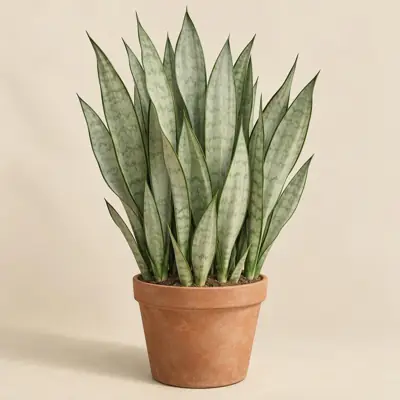
Overview
Dracaena trifasciata is an evergreen, succulent herbaceous perennial that grows in upright clumps from creeping rhizomes.
Origin and habitat
Sources differ on its native range, describing it as African and mainly associated with tropical western to central Africa from Nigeria toward the Democratic Republic of the Congo. It is reported to occur in dry parts of Africa. It is adapted to warm tropical environments with a dry season and tolerates drought, but does not tolerate low temperatures or prolonged excessive moisture.
Characteristics
With few sources available, mature height is reported at about 60.96–121.92 cm and mature spread at about 10–50 cm. It is generally reported to grow slowly and stores water in its leaves. Its leaves are thick, upright, and clustered from the base; sources differ in their descriptions, with Moonshine characterized by pale silver-green to silver-green leaves with darker green margins, while the species generally has sword-shaped to lance-shaped leaves. It can produce inflorescences of small greenish-white, pale greenish-white, or creamy-white flowers; Moonshine flowers are fragrant, though flowering is not a main ornamental feature indoors, and sources differ on flowering under cultivation, describing flowering from summer to autumn and rare flowering as a houseplant.
Light
It tolerates bright indirect light, part shade to sun, and low light; indoors it benefits from ample light, while strong direct summer sunlight should be avoided in a glasshouse environment. It tolerates bright light or part shade.
Watering
It is drought tolerant; allow the growing medium to dry before watering, avoid prolonged wetness or overwatering, and reduce watering substantially in winter. The stated winter watering interval is 30–60.
Humidity and airflow
With few sources available, preferred humidity is reported at about 30–50 %. It is generally reported to prefer low humidity and need good airflow.
Temperature and dormancy
With few sources available, the ideal temperature is reported at about 18–29 °C, with a reported minimum of about 10 °C. It is generally classified as RHS H1C and is frost tender; keep above freezing. It is generally reported to rest in winter.
Growing medium and mounting
Use a well-drained growing medium; loam or sandy soil with neutral to alkaline pH is listed, while containers can use a highly draining granular medium. It is generally reported to be prone to rot.
Feeding
During the spring-to-autumn growing period, slow-release chemical fertilizer or liquid fertilizer may be applied.
Propagation
It can be propagated by division, rhizome offsets, or leaf cuttings. For Moonshine, separating rooted offsets or dividing rhizomes more reliably retains the silver-green foliage, while plants from leaf cuttings may revert to a darker green, cross-banded appearance.
Common problems
Potential pests include scale insects, aphids, mealybugs, thrips, and weevils. Damping-off may occur, and prolonged excessive moisture can lead to root rot; overwatering is a major cultivation problem associated with root rot. In insufficient light, Moonshine's silver-green leaves may gradually become darker green. It tolerates drought and heat but is sensitive to low temperatures and winter wetness; cold damage can cause leaves to collapse and die.
Identification
Rhizomes form clumps, with thick, rigid, sword-shaped leaves growing upright from the base; the species has conspicuous alternating dark and light cross-bands and tolerates drought and low-light environments.
Photos


Sources
- Wikipedia (en): Dracaena trifasciata — CC BY-SA 4.0 · link
- Wikipedia (ja): サンセベリア — CC BY-SA 4.0 · link
- Wikipedia (de): Dracaena trifasciata — CC BY-SA 4.0 · link
- GBIF descriptions: Especies introducidas, exóticas, trasplantadas, invasoras y potencialmente invasoras obtenidas a par — per dataset · link
- NC State Plant Toolbox: Dracaena trifasciata — copyright (facts only) · link
- Wikipedia (it): Dracaena trifasciata — CC BY-SA 4.0 · link
- Wikipedia (pt): Dracaena trifasciata — CC BY-SA 4.0 · link
- TaiCOL 臺灣物種名錄: Dracaena trifasciata — CC BY 4.0 · link
- RHS Plants: Dracaena trifasciata — © RHS, facts only · link
- NHK みんなの趣味の園芸 植物図鑑: Dracaena (genus-level) — © NHK出版, facts only · link
- Shop 'Moonshine Snake Plant - Sansevieria moonshine' Care and Info | Planet Dese (planetdesert.com) — facts only (§12) · link
- Sansevieria Moonshine Snake Plant Care: Light & Propagation (www.plantsolve.com) — facts only (§12) · link
- Shop 'Moonshine Snake Plant - Sansevieria moonshine' Care and Info | Planet Desert — facts only (§12) · link
- How to Grow and Care for Sansevieria Moonshine | Succulent Alley — facts only (§12) · link