
viper's bowstring hemp (Dracaena trifasciata)
Dracaena trifasciata is an evergreen perennial succulent herb with an upright, clumping habit, underground or near-surface creeping rhizomes, and leaves that grow upward from the base.
Overview
Dracaena trifasciata is an evergreen perennial succulent herb with an upright, clumping habit, underground or near-surface creeping rhizomes, and leaves that grow upward from the base.
Origin and habitat
Sources differ on its native range, describing tropical to central Africa and generally pointing to an area from Nigeria to the Congo region. It is reported to occur in dry areas of Africa. It is native to warm tropical African environments, is drought tolerant, and is sensitive to low temperatures.
Characteristics
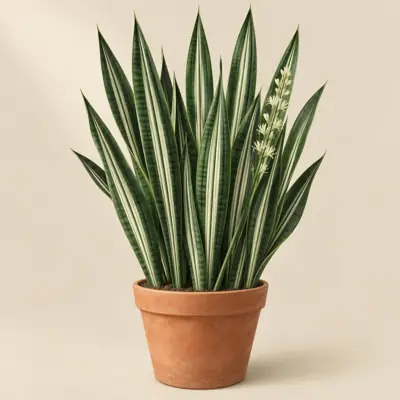
Sources differ on mature size, with a reported height of about 100–150 cm and, from few sources, a spread of about 10–50 cm. The stiff, upright leaves are sword-shaped to linear-lanceolate; the species typically has dark green leaves with paler gray-green transverse bands, while 'Bantel's Sensation' has white longitudinal stripes on dark green leaves. The small tubular flowers range from pale greenish white to creamy white, are sticky, and some are fragrant; sources differ on flowering season, and flowering is rare indoors. It is reported to store water in its leaves.
Light
It suits bright filtered light, part sun to sun, and can tolerate very low light; indoors, sudden exposure to strong direct summer sunlight should be avoided. It is generally suited to bright light or part shade.
Watering
It is drought tolerant; during active growth, allow the growing medium to dry before watering and avoid prolonged wetness, while watering should be greatly reduced in winter because overwatering readily causes root rot. In winter, watering is given every 30–60 days.
Humidity and airflow
It is generally reported to prefer low humidity and need good airflow.
Temperature and dormancy
Few sources report a minimum temperature of about 10 °C. It is generally reported to rest in winter.
Growing medium and mounting
It needs a well-drained growing medium; loamy or sandy media can be used, with a neutral to alkaline reaction, and containers can use a highly draining granular mix. It is prone to rot and needs a fast-draining mix.
Feeding
During the growing period from spring through autumn, it is reported that slow-release chemical fertilizer may be applied periodically, or liquid fertilizer more frequently.
Propagation
It can be propagated by division, separation of offsets, or leaf cuttings. Variegated forms may lose their original variegation when propagated from leaf cuttings, so division is more reliable when the variegated trait needs to be retained.
Common problems
Possible pests include scale insects, aphids, mealybugs, thrips, and weevils. Damping-off may occur, and excessive moisture can also lead to root rot. The main cultivation risk is root rot from overly wet growing medium or excessive watering; low temperatures can cause leaves to collapse or become damaged, while insufficient light can leave them weaker. It tolerates drought and heat but has weak cold tolerance, with low temperatures and excessive moisture being particular concerns in winter.
Identification
'Bantel's Sensation' is chiefly distinguished by white longitudinal stripes on dark green leaves, while the species itself has upright, stiff, sword-shaped leaves and a rhizomatous clumping habit.
Photos


Sources
- Wikipedia (en): Dracaena trifasciata — CC BY-SA 4.0 · link
- Wikipedia (ja): サンセベリア — CC BY-SA 4.0 · link
- Wikipedia (de): Dracaena trifasciata — CC BY-SA 4.0 · link
- GBIF descriptions: Especies introducidas, exóticas, trasplantadas, invasoras y potencialmente invasoras obtenidas a par — per dataset · link
- NC State Plant Toolbox: Dracaena trifasciata — copyright (facts only) · link
- Wikipedia (it): Dracaena trifasciata — CC BY-SA 4.0 · link
- Wikipedia (nl): Dracaena trifasciata — CC BY-SA 4.0 · link
- Wikipedia (pt): Dracaena trifasciata — CC BY-SA 4.0 · link
- RHS Plants: Dracaena trifasciata — © RHS, facts only · link
- NHK みんなの趣味の園芸 植物図鑑: Dracaena (genus-level) — © NHK出版, facts only · link