
Dracaena masoniana (Dracaena masoniana)
Dracaena masoniana is reported to be an upright, rhizomatous, semi-succulent herbaceous perennial.
Overview
Dracaena masoniana is reported to be an upright, rhizomatous, semi-succulent herbaceous perennial.
Origin and habitat
Dracaena masoniana is native to tropical Central Africa, with the Democratic Republic of the Congo specifically recorded as part of its native range. It is reported to occur in tropical environments.
Characteristics
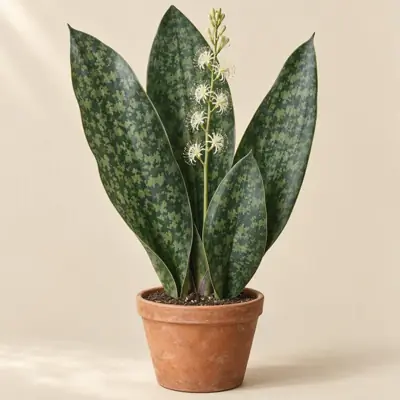
With few sources available, mature height is reported at about 91.44–152.4 cm and mature spread at about 30.48–60.96 cm. It is reported to grow slowly and to have large, thick, rigid, waxy, paddle-shaped leaves that are dark green with light green mottling; purple-striped leaf sheaths may be visible below the soil surface. It is reported to produce fragrant white flowers in clusters from the center of the plant. Flowering is reported in summer.
Light
Dracaena masoniana prefers bright indirect light, can tolerate low light or shade, and may suffer leaf scorch in direct sunlight. It tolerates bright light or part shade.
Watering
It is drought tolerant and can be watered infrequently; the growing medium should dry between waterings, with particular care to avoid overwatering.
Humidity and airflow
With few sources available, humidity is reported at about 50–100 %.
Temperature and dormancy
With few sources available, the minimum temperature is reported at about 12.78 °C. With few sources available, another cold-minimum record gives about 12.8 °C. It is reported to tolerate heat.
Growing medium and mounting
It is reported to need a well-drained, well-aerated growing medium that may include perlite, coarse sand, and organic matter. It is reported to adapt to acidic through neutral soil and to tolerate dry and poor soils. It generally needs a fast-draining mix.
Propagation
Dracaena masoniana is reported to be propagated by division or leaf cuttings.
Common problems
It is reported to be susceptible to spider mites, scale insects, mealybugs, thrips, and aphids. Overwatering is reported to be associated with black spot and root rot. Reported cultivation problems include root rot from overwatering and leaf scorch from direct sunlight. It is reported to be sensitive to cold drafts and cold conditions while tolerating heat, drought, and higher humidity.
Identification
Its large, rigid leaves resemble whale or shark fins, and cultivated plants are also often presented as a single large leaf in a pot.
Photos

