fishbone cactus (Disocactus anguliger)
Disocactus anguliger is an epiphytic, evergreen, succulent, shrubby cactus that branches freely from the base, with mature stems that may become pendent. It is reported to be an evergreen perennial.
Overview
Disocactus anguliger is an epiphytic, evergreen, succulent, shrubby cactus that branches freely from the base, with mature stems that may become pendent. It is reported to be an evergreen perennial.
Origin and habitat
Sources differ in describing its forest habitat, but report that it grows epiphytically on trees in mountain forests, including moist mountain forests and oak forests, generally beneath canopy shade. It is native to mid- to high-elevation forest environments in Mexico where there is shade and some humidity.
Characteristics
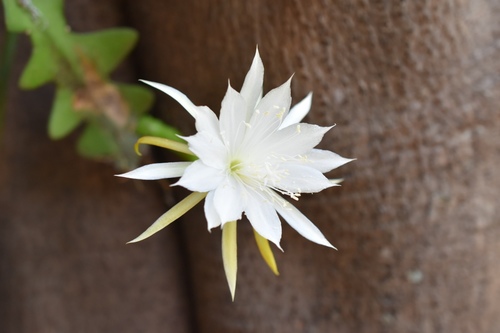
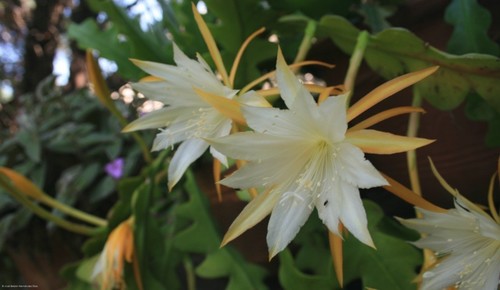
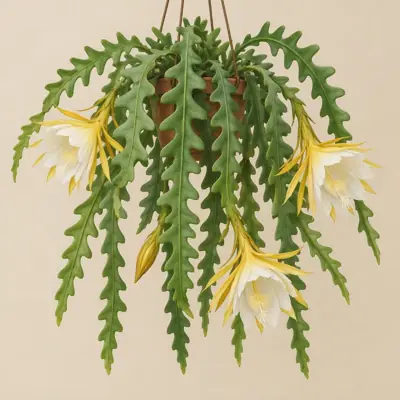
One source reports a mature height of about 100–100 cm, but sources are few. It is reported to grow rapidly. Sources differ in their descriptions, but the leaf-like lateral branches are actually flattened, succulent green stems that are lance-shaped, broadly toothed and deeply lobed; the base of the main stem may be cylindrical or three-angled. Sources differ in their descriptions of the large, fragrant flowers, which have lemon-yellow to golden-yellow outer perianth segments and white inner segments and are reported to open at night. Sources differ on flowering season, describing it as extending from late summer into early winter, with autumn as the main flowering period. The fruit is ovoid and may be brown, green or yellow when mature, with small black seeds inside.
Light
Disocactus anguliger favors bright light or part shade, with shade during hot periods; plants in their native habitat are reported beneath the tree canopy without direct sunlight.
Watering
It is reported to need more water during spring and summer growth, with the growing medium kept moist but not waterlogged; watering is reduced briefly after flowering and is more restrained at other times, with watering after the surface of the medium dries.
Humidity and airflow
It is reported to prefer high humidity.
Temperature and dormancy
Few sources report an ideal temperature range of about 16–25 °C. Few sources report about 10 °C as a minimum and about 25 °C as a maximum. For cold conditions, few sources report a minimum of about 10 °C.
Growing medium and mounting
An epiphytic growing medium is described as rich in humus and able to retain moderate moisture; other sources recommend a peat-based medium mixed with coarse sand or perlite and describe an acidic medium.
Propagation
It is reported to be propagated from seed and readily by vegetative propagation.
Common problems
Waterlogging should be avoided; root damage or inadequate nutrients are reported to cause deterioration in the plant's condition. It favors warm, humid and shaded conditions, and strong direct sunlight should be avoided during hot periods.
Identification
It is reported to have conspicuous green flattened stems with deeply lobed, broadly toothed, fishbone-like margins and large, fragrant white flowers; flower color and size can help distinguish it from other cacti commonly described as fishbone types.
Photos