
Disocactus ackermannii (Disocactus ackermannii)
Disocactus ackermannii is an evergreen, perennial, epiphytic cactus that branches from the base and develops arching, hanging stems; some sources also report occasional growth on rocks.
Overview
Disocactus ackermannii is an evergreen, perennial, epiphytic cactus that branches from the base and develops arching, hanging stems; some sources also report occasional growth on rocks.
Origin and habitat
Sources differ on its native range, describing southern Mexico and specifically listing Chiapas, Oaxaca, Puebla, and Veracruz. It is native to high-elevation tropical forest and cloud forest in southern Mexico, where it mainly grows epiphytically on trees, using bark to anchor its roots and favoring open positions under canopy shade; sources differ, with some also reporting occasional growth on rocks.
Characteristics
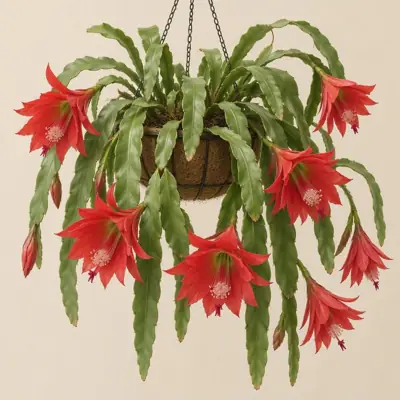
Sources differ on mature height, placing it at about 10–70 cm, while the few available sources report a mature spread of about 60–100 cm. It is generally reported to grow vigorously and flowers in spring. Sources differ in their descriptions of the large, curved to funnel-shaped flowers, which are mainly deep red to scarlet with a green throat. It lacks conventional leaves and instead has fleshy, leaf-like flattened stem segments with wavy or rounded-toothed margins and nearly cylindrical stem bases; its fruit is ovoid to elongated, green to brownish red, with white-pink flesh reported by some sources.
Light
Disocactus ackermannii does well in bright light or part shade, with bright, indirect light and shade during hot periods, while strong direct midday sun should be avoided.
Watering
Water regularly and relatively generously during the growing season, allowing the well-drained medium to dry slightly between waterings; keep it moist but not waterlogged while flowering, and reduce watering in winter and after flowering.
Humidity and airflow
It is reported to prefer high humidity.
Temperature and dormancy
The few available sources differ on a minimum temperature of about 0 °C, while another limited report gives about 1.67 °C. It is associated with USDA and RHS hardiness classifications, and is reported to be frost tender; keep above freezing. It is not frost tolerant and rests cool in winter with a little water.
Growing medium and mounting
As an epiphyte, Disocactus ackermannii needs a fast-draining mix that is slightly acidic, rich in organic matter, moisture-retentive yet well aerated, and may contain sphagnum moss; loamy and sandy media are also listed.
Feeding
During the growing season, it is generally recommended to use a balanced fertilizer suitable for acid-loving plants at reduced strength and at regular intervals, with feeding stopped in winter.
Propagation
It can be propagated by seed, stem cuttings, softwood cuttings, grafting, or other vegetative propagation, and vegetative propagation is described as easy. Seed may be sown when mature, while softwood cuttings may be taken later in spring.
Common problems
In greenhouse cultivation, scale insects and mealybugs are reported pests. Disease is generally reported to be uncommon, although excess moisture or poor drainage can lead to root rot. Moving the plant after flower buds have formed can cause bud drop. It is sensitive to frost, freezing, and strong midday sun; in cold regions, container growing and moving it to a protected environment are recommended.
Identification
Disocactus ackermannii branches from the base and has arching, hanging branches with elongated, leaf-like flattened stems; mature plants bear large scarlet to deep red funnel-shaped flowers with green throats.
Photos


Sources
- Wikipedia (en): Disocactus ackermannii — CC BY-SA 4.0 · link
- Wikipedia (de): Disocactus ackermannii — CC BY-SA 4.0 · link
- Wikipedia (fr): Disocactus ackermannii — CC BY-SA 4.0 · link
- Wikipedia (es): Disocactus ackermannii — CC BY-SA 4.0 · link
- LLIFLE Encyclopedia of living forms: Disocactus ackermannii — CC BY-SA · link
- Useful Tropical/Temperate Plants: Disocactus ackermannii — CC BY-NC-SA 3.0 (facts only) · link
- RHS Plants: Disocactus ackermannii — © RHS, facts only · link
- Top Tropicals catalog: Disocactus ackermannii — © Top Tropicals LLC (facts only) · link
- PUKUBOOK: Disocactus ackermannii — CC BY-NC (facts only) · link