
Dischidia ruscifolia (Dischidia ruscifolia)
Dischidia ruscifolia is an evergreen perennial epiphyte with slender stems that can creep, climb, or trail, making it suitable for hanging containers; the stem tips can root and continue extending. It is reported to be evergreen and perennial.
Overview
Dischidia ruscifolia is an evergreen perennial epiphyte with slender stems that can creep, climb, or trail, making it suitable for hanging containers; the stem tips can root and continue extending. It is reported to be evergreen and perennial.
Origin and habitat
Dischidia ruscifolia is native to the Philippines. It naturally occurs as an epiphyte in forests, spreading over trunks and branches, particularly branches approaching decay, and has also been recorded on exposed forest ridges, in lower-elevation thickets, on cliffs, and along rivers. It prefers warm conditions with some atmospheric humidity and does not tolerate cold or frost.
Characteristics
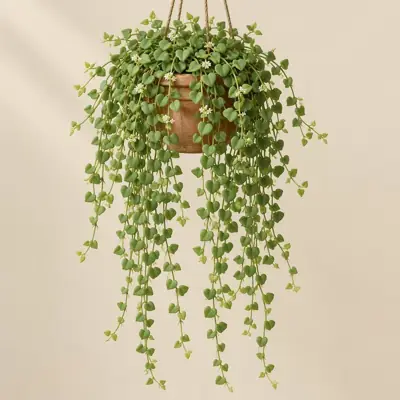
The small, thick, fleshy, relatively firm, heart-shaped leaves are usually densely paired along slender stems; they are green, while new leaves may be reddish and stronger light can also bring out red coloration. Sources differ in their descriptions of the very small white flowers, which arise from the leaf axils singly or in pairs, have a pointed-lobed corolla, and can remain for a relatively long time. It is reported to flower throughout the year, including while still young, and its fruit is reported to be pale green with a flat upper surface and a gradually tapering tip. Mature spread is 100 cm, and under suitable conditions the plant is reported to grow well and vigorously while remaining relatively compact.
Light
Partial shade, bright shade, or bright indirect light is preferred; intense direct midday summer sun may scorch the leaves, while stronger filtered light can promote reddish foliage and flowering.
Watering
Sources differ on watering guidance: water regularly during the growing season while allowing the medium to dry slightly between waterings, avoid prolonged wetness that can damage roots, and reduce watering substantially in winter while maintaining good ventilation.
Humidity and airflow
It is reported to prefer high humidity and to need good airflow.
Temperature and dormancy
Few sources report an ideal temperature of about 20–25 °C and a minimum of about 10 °C. Dischidia ruscifolia is frost tender; keep above freezing. Sources differ on its hardiness-zone classification.
Growing medium and mounting
It needs a well-drained, loose, root-aerating medium that also retains some moisture; cited examples include orchid medium, chopped coconut husk, or peat combined with fibrous material, sand, and coarse drainage materials such as perlite or pumice.
Feeding
During the growing season, it is reported to benefit from fertilizer higher in potassium and phosphorus and lower in nitrogen.
Propagation
It is readily propagated from stem cuttings, which can be rooted in water, soil, or a sterile medium such as perlite.
Common problems
It is reported to be susceptible to mealybugs on stems and roots, while tissue damage from pests may be followed by fungal infection and cold, wet winter conditions may also encourage fungal problems. Prolonged wetness in the potting medium is reported to cause root loss; excessive water combined with too much shade may produce swollen, untidy growth, while overly dry indoor heating conditions in winter may also reduce plant condition. It is sensitive to frost and low temperatures, and intense midday summer light may scorch the leaves; outdoor plants should be moved to protected conditions before nights become too cold.
Identification
Dischidia ruscifolia is distinguished by slender trailing stems densely lined with paired, small, heart-shaped succulent leaves that create a continuous chain of hearts, together with tiny white flowers in the leaf axils.
Photos

