
Cycad (Dioon edule)
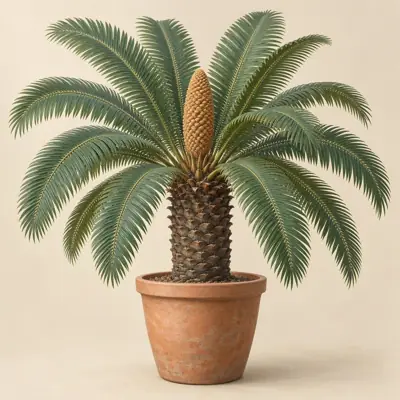
Dioon edule is an evergreen, perennial, palm-like woody cycad with a stout trunk that is usually upright or reclining and unbranched, bearing a crown of leaves at the top.
Overview
Dioon edule is an evergreen, perennial, palm-like woody cycad with a stout trunk that is usually upright or reclining and unbranched, bearing a crown of leaves at the top.
Origin and habitat
Dioon edule is endemic to eastern Mexico, mainly on the eastern side of the Sierra Madre Oriental, including Hidalgo, Querétaro, San Luis Potosí, southern Tamaulipas, and Veracruz. Sources differ in describing its habitat, which includes transitional vegetation between tropical deciduous forest and oak forest, as well as rocky ground, shallow soils, and steep rocky slopes where drought and wildfire can occur. Its native environment is reported to include seasonally dry areas, and the plant is reported to tolerate drought, with some habitats frequently experiencing dry conditions and wildfire.
Characteristics
Sources differ, but mature plants are reported at about 100–300 cm tall; a single source reports a spread of about 100–150 cm. Growth is slow, and the large, stiff pinnate leaves form a crown at the stem tip; the petiole is usually spineless, while mature leaflets lack marginal spines and seedlings and young plants may have them. Plants are dioecious and bear cones in the center of the leaf crown, with larger female cones and narrower, elongated cylindrical male cones. A female plant is reported to usually form a seed cone in each reproductive cycle, with the cone containing starch-rich seeds.
Light
Dioon edule takes full sun and grows best in full sun, while tolerating partial shade; in greenhouse cultivation, excessively intense hot sunlight should be avoided.
Watering
It is reported to need ample water during active growth while the growing medium remains well drained, with watering reduced in winter.
Temperature and dormancy
With only a single source, the reported cold minimum is about -5 °C.
Growing medium and mounting
It is reported to grow in clay, loam, or sandy media that remain moist but well drained, with acidic to neutral soil suitable; greenhouse cultivation can use a mixture of fibrous loam, coarse bark, and horticultural compost in equal proportions.
Feeding
A balanced liquid fertilizer is reported to be applied regularly during the growing period.
Propagation
It is reported to be propagated by seed, which can be sown in spring in a medium with a high proportion of sand.
Common problems
In greenhouse cultivation, scale insects are reported as a possible pest, while obvious disease problems are generally not reported. Growth is very slow; low temperatures may damage leaves or cause complete leaf loss, and poor drainage does not meet its cultivation needs. It tolerates drought, hot sun, and some frost, but lower temperatures can damage leaves or cause leaf loss; mature plants have protective structures that can withstand frequent fires in their native habitat.
Identification
Mature plants are reported to lack spines along the leaflet margins, an important feature distinguishing Dioon edule from some other Dioon species; seedlings and young plants may temporarily have marginal leaflet spines that disappear at maturity.
Photos


Sources
- Wikipedia (en): Dioon edule — CC BY-SA 4.0 · link
- Wikipedia (ja): ディオオン・エデュレ — CC BY-SA 4.0 · link
- Wikipedia (de): Dioon edule — CC BY-SA 4.0 · link
- Wikipedia (fr): Dioon edule — CC BY-SA 4.0 · link
- Wikipedia (es): Dioon edule — CC BY-SA 4.0 · link
- Useful Tropical/Temperate Plants: Dioon edule — CC BY-NC-SA 3.0 (facts only) · link
- RHS Plants: Dioon edule — © RHS, facts only · link
- PACSOA wiki: Dioon edule — © Palm & Cycad Societies of Australia (PACSOA) and credited contributors, facts only · link