
Venus flytrap (Dionaea muscipula)
Dionaea muscipula is a low-growing, rosette-forming, clumping perennial herbaceous carnivorous plant. Sources differ in their descriptions of its perennial life cycle.
Overview
Dionaea muscipula is a low-growing, rosette-forming, clumping perennial herbaceous carnivorous plant. Sources differ in their descriptions of its perennial life cycle.
Origin and habitat
Sources differ somewhat on the native range, placing it in the southeastern United States with a core range in North Carolina and South Carolina, especially a restricted area along coastal North Carolina and northeastern South Carolina. It inhabits wet, nutrient-poor, acidic wetlands, including coastal marshes, wet pine lowlands, and wet pine grasslands, where substrates may contain peat and sand. Its native temperate-to-subtropical wetlands in the southeastern United States have distinct seasonal changes, and winter cold can induce dormancy.
Characteristics
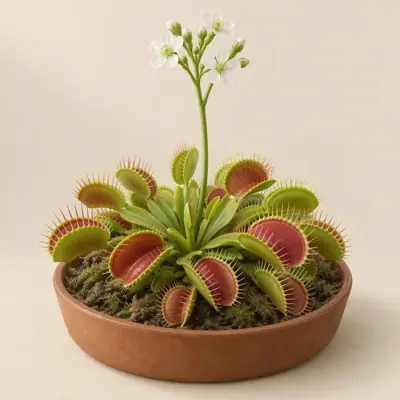
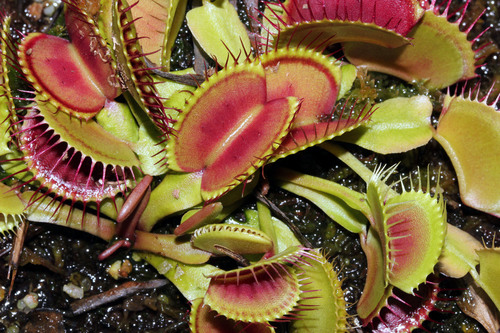
Sources differ and are few on mature height, placing it at about 5–10 cm; mature spread is 10–50 cm. Leaves form a central rosette, with hinged, two-lobed traps at the ends of the petioles; their inner surfaces may be pink, red, orange-red, or purple, with stiff marginal bristles that interlock on closing and sensory hairs inside. Small white, petaled flowers are borne in inflorescences on stalks above the foliage, with flowering occurring during a seasonal period. It is reported to grow relatively slowly, and after pollination the ovary enlarges and later matures into a black, nearly round fruit containing many black seeds.
Light
It grows in full sun to partial sun and needs abundant light during active growth, while strong afternoon sun may be avoided during extreme heat.
Watering
Keep the medium wet rather than allowing it to dry completely; tray (bottom) watering is compatible and may be used. Use pure water only (rain, RO or distilled); cultivation sources advise avoiding hard or treated tap water.
Humidity and airflow
Humidity is 80–100%, consistent with a preference for high humidity. It is generally reported to need good airflow.
Temperature and dormancy
Sources are few and report an ideal temperature of about 25–30 °C. USDA hardiness zones are specified, with NCSU indicating that winter protection can extend cultivation into colder zones; sources differ on the minimum temperature. It tolerates brief light frost and has cold winter dormancy.
Growing medium and mounting
Use a low-fertility, acidic medium that stays moist while retaining aeration; suggested materials include sphagnum moss, peat with coarse sand or vermiculite, and other low-nutrient mixes. Sand with peat is also generally reported as a substrate type.
Feeding
Fertilizer is generally not applied, and high-nutrient media should be avoided. It is reported to grow without additional feeding of insects.
Propagation
It can be propagated by seed or division.
Common problems
Possible pests include aphids, spider mites, mealybugs, and fungus gnats, while disease problems are generally reported to be uncommon. Dry medium, excessive nutrients, hard water, or treated water can cause growth problems; insufficient light can produce weak, elongated leaves, while oversized prey that decays can cause traps to wither. Sources differ on weather sensitivity: afternoon shade and increased airflow may be used during intense summer heat, while some cold is tolerated; Top Tropicals describes tolerance of brief light frost but also describes the plant as frost-sensitive on the same page.
Identification
The leaf tips form jaw-like traps that can close rapidly; after prey stimulates the sensory hairs, the trap lobes close and marginal bristles restrict escape, after which digestive fluid can be secreted and nutrients absorbed.
Photos



Sources
- GBIF Backbone: Dionaea muscipula Ellis — CC BY 4.0 · link
- Wikipedia (en): Venus flytrap — CC BY-SA 4.0 · link
- 維基百科:捕蠅草 — CC BY-SA 4.0 · link
- Wikipedia (ja): ハエトリグサ — CC BY-SA 4.0 · link
- Wikipedia (de): Venusfliegenfalle — CC BY-SA 4.0 · link
- Wikipedia (fr): Dionée attrape-mouche — CC BY-SA 4.0 · link
- Wikipedia (es): Dionaea muscipula — CC BY-SA 4.0 · link
- NC State Plant Toolbox: Dionaea muscipula — copyright (facts only) · link
- RHS Plants: Dionaea muscipula — © RHS, facts only · link
- USDA PLANTS Database: Dionaea muscipula — Public domain (US Government work) · link
- Tom's Carnivores: Dionaea (genus-level) — © Tom's Carnivores, facts only · link
- NHK みんなの趣味の園芸 植物図鑑: Dionaea muscipula — © NHK出版, facts only · link
- Top Tropicals catalog: Dionaea muscipula — © Top Tropicals LLC (facts only) · link